Opening Reality Check
Read This Before You Sign Anything
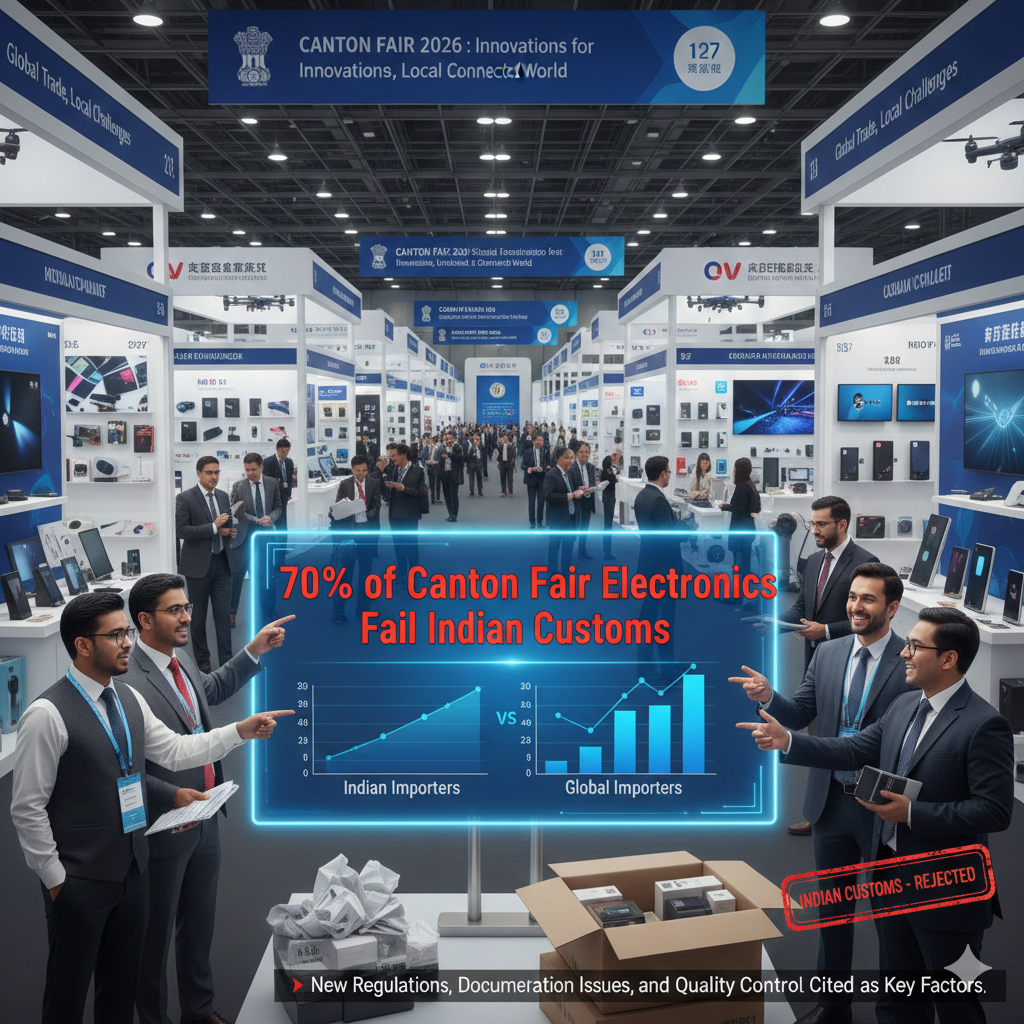
If you believe finding a supplier at Canton Fair means the product is import-ready for India, you are already on the path to detention.
The China Import and Export Fair is a sourcing exhibition.
It is not designed to align products with Indian law.
Most first-time Indian buyers walk the halls, negotiate prices, exchange cards, and finalize electronics without asking a single India-specific compliance question. That is not optimism. That is negligence.
Indian Customs does not care:
how reputed your Chinese factory is,
how many countries they export to,
or what certificates they “usually provide”.
They care only about Indian statutes, Indian regulators, and Indian port enforcement.
Canton Fair – Phase 1
Where Electronics Buyers Get Trapped
Typical electronics sourced here:
LED lights, drivers, panels
Power banks, chargers, adapters
Smart devices, IoT products
Electrical appliances
Switches, sockets, wiring accessories
Solar components
Bluetooth / wireless gadgets
This phase produces the highest number of detained containers in India. Not because products are bad because compliance is ignored at sourcing stage.
Top Import Mistakes Made at Canton Fair (Electronics)
1. Selecting Products Without BIS Mapping
Buyers ask about price, MOQ, delivery, but not:
“Is this model covered under BIS CRS?”
“Is BIS registration in my Indian entity name?”
Result: Goods arrive. BIS is missing or invalid. Clearance stops.
2. Assuming Chinese Suppliers “Will Handle Certificates”
They cannot. They should not. And legally, they are not responsible.
BIS registration holder must be an Indian entity
WPC ETA applicant must be Indian
LMPC importer declaration is your liability
If your supplier says “we will manage”, you are being misled.
3. Ignoring Wireless Components Inside Products
Even a Bluetooth chip inside a lamp triggers WPC/ETA.
Customs does not inspect your invoice. They inspect the product internals.
4. Finalizing Packaging Without Indian Labels
If your retail box lacks:
Importer name & address
Country of origin
MRP (₹)
Month/year of import
Customer care details
Your cargo is non-compliant even if the product is perfect.
India-Specific Compliance Traps (Electronics)
1. Selecting Products Without BIS Mapping
Buyers ask about price, MOQ, delivery, but not:
“Is this model covered under BIS CRS?”
“Is BIS registration in my Indian entity name?”
Result: Goods arrive. BIS is missing or invalid. Clearance stops.
2. Assuming Chinese Suppliers “Will Handle Certificates”
They cannot. They should not. And legally, they are not responsible.
BIS registration holder must be an Indian entity
WPC ETA applicant must be Indian
LMPC importer declaration is your liability
If your supplier says “we will manage”, you are being misled.
3. Ignoring Wireless Components Inside Products
Even a Bluetooth chip inside a lamp triggers WPC/ETA.
Customs does not inspect your invoice.
They inspect the product internals.
4. Finalizing Packaging Without Indian Labels
If your retail box lacks:
Importer name & address
Country of origin
MRP (₹)
Month/year of import
Customer care details
Your cargo is non-compliant even if the product is perfect.
India-Specific Compliance Traps (Electronics)
BIS – Compulsory Registration Scheme (CRS)
Bureau of Indian Standards
Applies to:
LED lights
Power supplies
IT & electronic equipment
Consumer electronics
Reality:
BIS must be obtained before manufacturing
Testing is model-specific
Brand owner/importer liability applies
No BIS = no clearance. Period.
WPC / ETA – Wireless Planning & Coordination
Wireless Planning and Coordination Wing
Applies if product contains:
Bluetooth
Wi-Fi
RF modules
Zigbee / NFC
Reality:
ETA required before shipment
Frequency band must be license-exempt
Test report from accredited lab mandatory
“Low power device” is not an exemption. It is a myth.
LMPC – Legal Metrology (Packaged Commodities)
Department of Consumer Affairs
Applies to any retail-packed electronics.
Reality:
Registration required before import
Labeling must be pre-approved
Stickering at port is risky and often rejected
EPR – Extended Producer Responsibility
Central Pollution Control Board
Applies to:
Electronic waste
Batteries
Chargers
Power banks
Reality:
Mandatory registration
Annual compliance reporting
Non-compliance blocks clearance and future imports
What Actually Happens at Indian Ports (Not What You’re Told)
Detention Timeline
Day 1–3: Query raised
Day 4–10: Document verification
Day 11+: Sampling / testing / legal opinion
Costs You Did Not Budget For
Container detention: ₹5,000–₹10,000 per day
CFS demurrage: ₹8,000–₹15,000 per day
Testing charges
Port handling re-charges
Worst-Case Outcomes
Forced re-export
Destruction under Customs supervision
Penalties under Customs Act
Blacklisting for repeat violations
Your “test import” becomes a six-figure loss.
Premji Kanji Masani Private Limited (PKM) Practical Insight
What Experienced Customs Brokers Do Differently
At Premji Kanji Masani Private Limited, operational since 1963, we intervene before money leaves India, not after cargo lands.
Critical checks done pre-PO:
HSN-wise compliance mapping
BIS/WPC/LMPC applicability confirmation
Label draft vetting
Sample technical specification review
Supplier declaration scrutiny
This is not advisory theory. This is port-tested reality.
Pre-Canton Fair Checklist for Indian Electronics Buyers
Before Finalizing Any Product
Identify exact model number
Map Indian compliance requirements
Confirm if BIS CRS applies
Check wireless components
Validate retail packaging format
Questions You Must Ask Suppliers
Is this exact model BIS tested?
Can manufacturing wait until BIS approval?
Are wireless modules pre-certified?
Can labels be printed as per Indian law?
When to Consult a Customs Broker
Before issuing PO
Before paying advance
Before approving packaging
Before shipment booking
If you consult after shipment, options shrink fast.
Closing Reality
The Canton Fair rewards speed and negotiation. Indian Customs rewards preparation and compliance.
If you are reading this while still in China, you still have time to avoid a detained container.
Premji Kanji Masani Private Limited (PKM) has been preventing such losses for Indian importers since 1963.
Clearing Your Cargo, Retaining Your Trust, Since 1963.
Before your first shipment leaves China, pause.
A pre-shipment compliance review is not an expense.
It is the difference between clearance and catastrophe.


