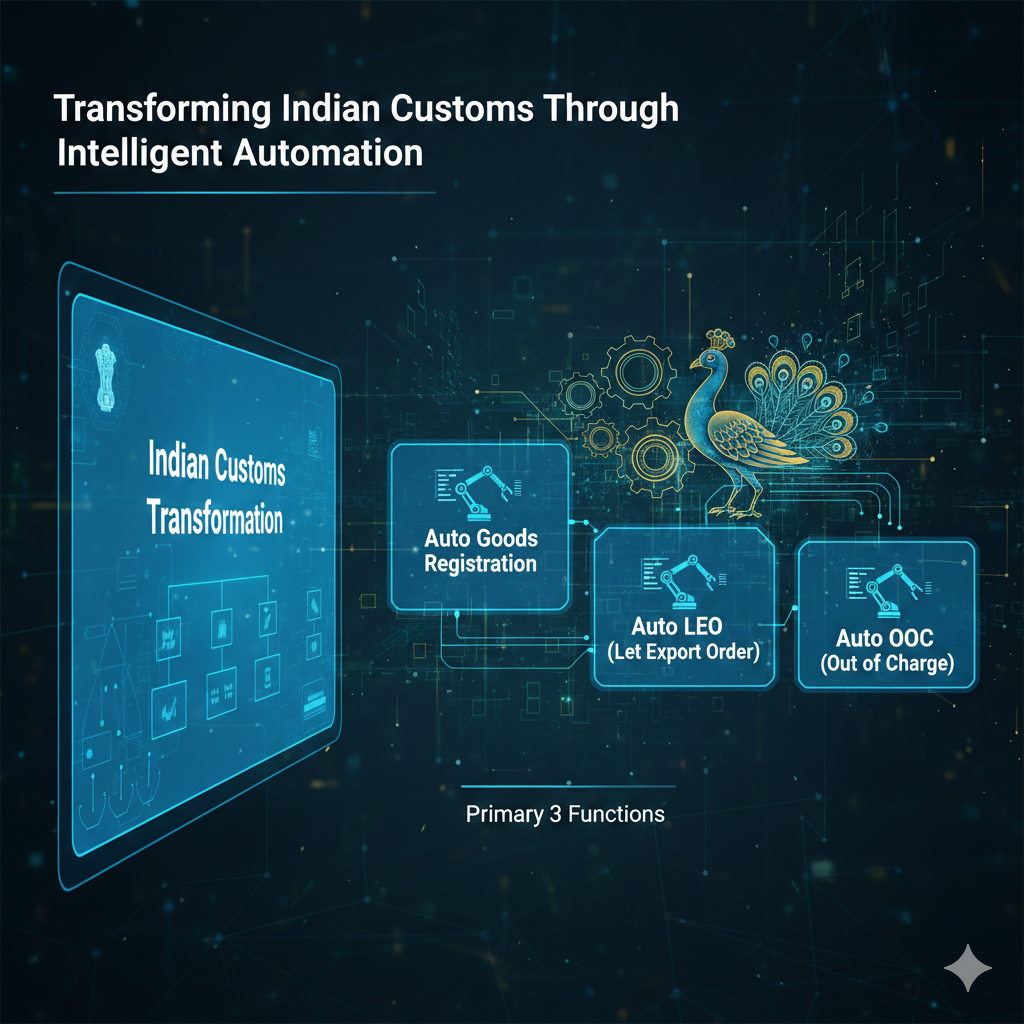
The Central Board of Indirect Taxes and Customs (CBIC) has just unveiled Circular 06/2026, and if you’re in the trade facilitation business, you know this isn’t just another regulatory update it’s a watershed moment for Indian customs operations.
After two decades of navigating the complexities of import-export compliance, I can confidently say we’re witnessing the most significant structural shift in customs clearance since the introduction of ICEGATE. Let me break down what this means for the trade community and why the technical architecture behind these changes matters.
The Three Pillars of Automation
1. Auto Goods Registration & Auto Out-of-Charge: The Import Revolution
The extension of automatic goods registration beyond AEO license holders represents a fundamental reimagining of import workflows.
Who benefits immediately:
- AEO-T2 and AEO-T3 importers (finally, recognition of compliance investment)
- Approved Eligible Manufacturer Importers under Notification 12/2026
- Importers with established supply chain patterns
- DPD (Direct Port Delivery) participants
But here’s the game-changer: Auto Out-of-Charge is now universal. Previously, only AEO importers enjoyed automated OOC. Now, every compliant importer—provided duties are paid and no red flags exist will experience seamless cargo release.
From a technical standpoint, this requires sophisticated backend integration between ICEGATE, duty payment gateways, and risk management systems. The system must verify duty payment confirmation, cross-reference compliance databases, and execute release orders all within minutes, not hours.
Practical impact: For time-sensitive cargo like pharmaceuticals, perishables, or just-in-time manufacturing inputs, this eliminates the dreaded “waiting for OOC” bottleneck that has plagued importers despite clean documentation.
2. E-Seal Based Auto Goods Registration for Exports: Plugging the Last Physical Touchpoint
This is where technology meets ground reality in the most tangible way.
The traditional export goods registration process required physical verification at container yards a process vulnerable to delays, manual errors, and varying interpretations across locations. The introduction of e-seal-based automatic registration fundamentally eliminates this friction point.
The technical framework:
- E-seals (electronic security devices) applied to export containers
- RFID/IoT scanners at terminal gates automatically read seal data
- System validates container details against Shipping Bill information
- Automatic goods registration triggered without human intervention
Starting with Nhava Sheva (INNSA1)—India’s largest container port—makes strategic sense. The pilot will stress-test the system under high-volume conditions before nationwide rollout.
Critical consideration: This requires infrastructure investment in e-seal scanners across ports and CFSs. The circular wisely acknowledges this by phasing implementation based on scanner installation completion.
For exporters, this means: seal your container, and the system handles the rest. No queues, no paperwork, no discretionary delays.
3. Auto Let Export Order (LEO): The Final Mile Automation
The automated LEO completes the export clearance loop.
Eligibility criteria are straightforward:
- Shipping Bill not selected for assessment or examination
- No PGA (Participating Government Agency) approvals pending
- All applicable duties/cess paid
This is risk-based facilitation at its finest. The system runs backend checks across multiple parameters—HS code classification patterns, exporter compliance history, destination risk profiles, consignment value anomalies—and if everything aligns, the LEO is generated automatically.
The backend intelligence: Auto-LEO relies on machine learning algorithms that continuously refine selection criteria based on historical data, seizure patterns, and compliance metrics. It’s not just automation; it’s intelligent automation.
The Risk Management Architecture
Here’s what separates mature automation from reckless deregulation: the HOLD mechanism.
Even under auto-OOC and auto-LEO regimes, customs officers retain the authority to apply a HOLD based on intelligence inputs. This preserves the critical oversight function while eliminating routine, low-risk interventions.
Think of it as moving from manual driving to autopilot with override capability. The system handles 95% of compliant transactions seamlessly, while human expertise focuses on the 5% that genuinely requires scrutiny.
From a compliance perspective, this also means intelligence-driven enforcement will become more targeted and effective. Random checks decrease; specific, actionable interventions increase.
What This Means for Customs Brokers and Trade Professionals
Short-term adjustments:
- Client education: Many importers/exporters won’t immediately understand that their cargo can now move without the traditional “waiting for approval” stages. Proactive communication is essential.
- Process reengineering: Customs brokers need to update Standard Operating Procedures to account for automated workflows. Your value proposition shifts from “expediting approvals” to “ensuring compliance parameters for seamless automation.”
- Technology integration: If you’re still operating on legacy systems, now is the time to upgrade. Real-time tracking, automated duty calculations, and API-based ICEGATE integration become table stakes.
Long-term evolution: The role of customs brokers evolves from transaction processors to compliance strategists. Your expertise in classification, valuation, scheme benefits, and regulatory interpretation becomes more valuable, not less—because getting these elements right determines whether clients qualify for automation or face manual intervention.
Technical Implementation Challenges to Watch
While the vision is compelling, execution will face hurdles:
- System stability under load: ICEGATE already experiences occasional latency during peak hours. Adding automated decision-making workflows increases system dependency.
- Inter-agency coordination: Auto-LEO working seamlessly requires real-time data exchange with FSSAI, DGFT, Textile Committee, and other PGAs. Legacy systems and data silos could create bottlenecks.
- E-seal standardization: Multiple e-seal vendors exist with varying technical specifications. Ensuring scanner compatibility across manufacturers will be critical.
- Audit trail integrity: Automated processes must maintain comprehensive logs for post-clearance audits. Transparency in algorithmic decision-making will be scrutinized.
The Strategic Vision: Contactless, Paperless, Seamless
CBIC’s stated goal of “Contactless, Paperless & Seamless Customs” aligns India with global best practices seen in Singapore, Hong Kong, and Rotterdam. The circular explicitly acknowledges international trade competitiveness as a driver.
For businesses, this translates to:
- Predictable clearance timelines: Automated processes operate 24/7 without human-induced delays
- Cost reduction: Fewer physical interventions mean lower demurrage, container detention, and operational costs
- Transparency: System-driven decisions are auditable and consistent across locations
- Scalability: As trade volumes grow, automated systems scale more efficiently than manual processes
Action Items for Trade Community
For Importers:
- Ensure your IEC compliance history is clean (auto-OOC depends on it)
- Verify duty payment mechanisms are integrated with ICEGATE for real-time confirmation
- If you’re an eligible manufacturer, confirm your status under Notification 12/2026
For Exporters:
- Engage with your CFS/port about e-seal availability and procedures
- Review your Shipping Bill filing accuracy—automation magnifies the cost of errors
- Understand PGA approval timelines to avoid auto-LEO exclusions
For Customs Brokers:
- Invest in training staff on new automated workflows
- Develop client advisories explaining the changes
- Upgrade technical infrastructure to handle API-based interactions
Conclusion: Evolution, Not Disruption
Circular 06/2026 represents evolutionary progress built on years of foundational work—ICEGATE development, AEO program maturation, risk management system refinement. It’s not disruptive change; it’s the logical next step.
For those of us who’ve watched customs operations evolve from paper-based manual processing to today’s digital ecosystem, this moment feels significant. We’re moving from “government as gatekeeper” to “government as enabler”—with smart systems handling compliance verification so legitimate trade flows freely.
The winners will be those who embrace the shift: upgrade systems, maintain impeccable compliance, and leverage automation as competitive advantage. The laggards who resist technology adoption will find themselves increasingly marginalized in a system designed for digital-first operations.
India’s customs modernization journey continues, and with initiatives like these, we’re not just catching up to global standards—we’re setting new benchmarks for developing economies worldwide.


