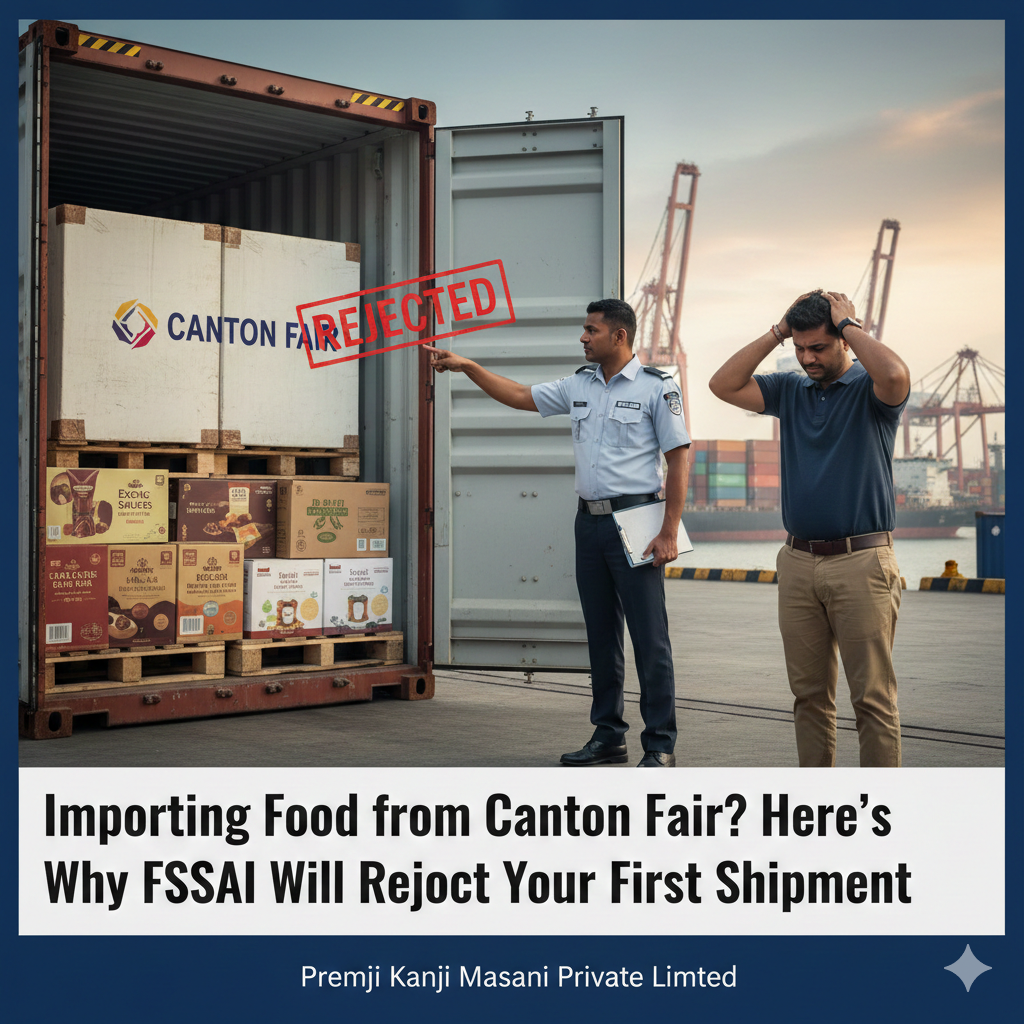
You’ve just returned from Canton Fair Phase 3 (May or October session), excited about the exotic sauces, premium chocolates, protein bars, or bubble tea ingredients you sampled. The Chinese supplier’s catalog looks professional. The FOB price fits your margin. The samples taste perfect.
But here’s what 60+ years at Indian ports has taught us at Premji Kanji Masani Private Limited:
Finding a supplier at Canton Fair does not mean the product can legally enter India.
Most Indian buyers treat Canton Fair as a product discovery event. They sign purchase orders based on pricing and product appeal. Nobody asks about FSSAI compliance until the container lands at Nhava Sheva or Mundra — and by then, it’s too late.
Canton Fair Phase 3: Where Food Import Disasters Begin
Phase 3 (Food & Beverages, Textiles, Medical) is when Indian SMEs and first-time importers crowd the food pavilions looking for:
- Health supplements (whey protein, collagen powders, vitamins)
- Confectionery (gummy candies, chocolate bars, cookies)
- Sauces and condiments (chili oil, soy sauce, cooking pastes)
- Beverages (energy drinks, fruit concentrates, bubble tea mixes)
- Specialty ingredients (enzymes, food additives, natural extracts)
- Ready-to-eat snacks (chips, instant noodles, dried fruits)
Every booth displays English labels. Every supplier claims “we export globally.” Every buyer assumes global export = India-ready.
That assumption costs Indian importers ₹8–15 lakhs per rejected container.
Top 5 Import Mistakes Indian Buyers Make at Canton Fair (Food Category)
Mistake #1: Accepting Chinese Nutritional Labels as “Compliant”
Your supplier prints nutritional information in English. It looks professional. It even has allergen warnings.
Reality: FSSAI mandates specific font sizes, bilingual declarations (English + Hindi), Veg/Non-Veg symbols (Green/Brown dot), FSSAI logo, manufacturer/importer address in India, and country of origin in prescribed format. Chinese export labels rarely match these requirements.
Mistake #2: Assuming “Food Grade Certificate” Equals FSSAI Approval
Suppliers show ISO 22000, HACCP, or FDA certificates. Indian buyers think these cover Indian compliance.
Reality: FSSAI requires India-specific import licenses, product approvals, and adherence to Food Safety Standards (FSS) Regulations 2011. No international certificate substitutes FSSAI registration.
Mistake #3: Importing Health Supplements Without NUTRACEUTICAL Approval
Protein powders, collagen drinks, herbal capsules — these are classified as nutraceuticals or health supplements under FSSAI.
Reality: Nutraceuticals require FSSAI product approval before import. Without pre-approved registration, Customs won’t release the consignment. The approval process takes 60–90 days. You cannot “apply after arrival.”
Mistake #4: Ignoring Permitted vs. Prohibited Food Additives
Chinese food products often contain additives, preservatives, or colorants permitted in China but banned in India under FSS (Food Products Standards and Food Additives) Regulations 2011.
Reality: If lab testing at the port reveals Sunset Yellow, Ponceau 4R, or any non-permitted additive, the entire shipment is destroyed. No appeal. No re-export option if food safety is violated.
Mistake #5: Ordering Products Without Knowing Shelf Life Rules
FSSAI requires imported food to have at least 60% of shelf life remaining at the time of import (for products with <3 months shelf life) or minimum validity as per product type.
Reality: If your chocolate bars expire in 8 months and you ship them 4 months before expiry, they fail shelf-life compliance. The container gets stuck. Demurrage piles up while you argue with your supplier.
India-Specific Compliance Traps for Food Imports from China
1. FSSAI Import License (Mandatory)
You cannot import food without a valid FSSAI Import License. This is separate from your IEC (Import Export Code). Processing time: 2–3 months.
2. FSSAI Product Approval (For Certain Categories)
- Nutraceuticals, health supplements, fortified foods, novel ingredients, infant foods, irradiated foods, GM foods — all require prior product approval from FSSAI.
- Approval requires product formulation, manufacturing process, safety studies, and lab test reports.
3. Bilingual Labeling (English + Hindi)
- Mandatory declarations: Product name, ingredients list (in descending order of composition), nutritional information, allergen warnings, FSSAI logo (with license number), Veg/Non-Veg symbol, net quantity, MRP (if selling retail in India), country of origin, importer name/address.
- Font size: Minimum 1.5mm for declarations on packages <100 sq. cm; 2mm for larger packs.
4. Laboratory Testing at Port
Every food consignment is subject to random or mandatory sampling by FSSAI-designated labs. Tests check for:
- Microbial contamination (E. coli, Salmonella, yeast/mold)
- Heavy metals (lead, arsenic, mercury)
- Pesticide residues
- Prohibited additives or colors
- Nutritional claim verification (if product claims “high protein” or “sugar-free”)
Test failure = destruction or re-export at importer’s cost.
5. WPC/ETA (For Certain Products)
If your imported food product contains electronics (e.g., battery-operated beverage dispensers, smart food containers), you also need Wireless Planning & Coordination (WPC) approval or Equipment Type Approval (ETA).
6. EPR (Extended Producer Responsibility)
If your food packaging uses plastic (pouches, bottles, wrappers), you must register for EPR under Plastic Waste Management Rules 2016. This applies to importers as well.
What Actually Happens When FSSAI Compliance Fails at Indian Ports
Timeline of a Rejected Food Shipment (Real Case from PKM Files)
Day 1–3: Container arrives at Nhava Sheva. Bill of Entry filed. FSSAI documents uploaded.
Day 4: FSSAI officer notices labeling discrepancies during document scrutiny. Orders physical examination.
Day 7: Physical examination reveals:
- No FSSAI logo on product labels
- No Veg/Non-Veg symbol
- Nutritional information in Chinese (not bilingual)
- Ingredient list incomplete (missing allergen declaration)
Day 8: FSSAI draws samples. Sends to designated lab for testing.
Day 18: Lab report shows presence of Tartrazine (food color) — banned under FSS Regulations.
Day 20: FSSAI issues “Detention Notice.” Consignment declared non-compliant.
Importer’s Options:
- Re-export: Ship the container back to China. Cost: ₹3–5 lakhs (shipping + penalty + detention charges).
- Destruction: Destroy the consignment at approved facility. Cost: ₹2–4 lakhs + container detention (₹15,000–₹25,000 per day).
- Appeal: File appeal with FSSAI. Success rate: <5% for labeling/additive violations. Time: 60–90 days. Demurrage keeps running.
Total Loss: ₹8–15 lakhs (product cost + freight + demurrage + destruction).
What 60+ Years of Customs Clearance Has Taught Us
At Premji Kanji Masani Private Limited, we clear Food Ingredients, Enzymes, Additives, Confectionery, Health Supplements, and Specialty Food Products. We’ve seen hundreds of Canton Fair imports fail FSSAI checks.
Here’s what works:
Pre-Shipment Label Audit
Before your supplier prints the labels, send us:
- Product formulation
- Proposed label artwork
- Ingredient list
- Nutritional values
We audit the label against FSSAI regulations and send back corrections. This prevents 90% of detention cases.
Pre-Import FSSAI Product Approval Assistance
For nutraceuticals, fortified foods, or novel ingredients, we help coordinate:
- FSSAI product approval application
- Lab testing (in India or China, as per FSSAI requirements)
- Documentation support
Approval takes 60–90 days. Start this BEFORE you place the purchase order.
Lab Pre-Testing (Optional but Smart)
If you’re importing a new product category or a new supplier, we recommend sending a sample to an FSSAI-accredited lab in India for pre-testing. Cost: ₹15,000–₹30,000.
Benefit: You know if the product will pass FSSAI testing at the port. If it fails pre-testing, you can either change suppliers or reformulate the product.
Supplier Compliance Questionnaire
Before signing the purchase order at Canton Fair, ask your supplier:
- “Can you provide FSSAI-compliant labels (English + Hindi, with prescribed declarations)?”
- “Does your product contain any food additives? If yes, provide the list with INS numbers.”
- “What is the shelf life? When will you manufacture this batch?”
- “Can you share lab test reports for heavy metals, pesticides, and microbial contamination?”
- “Have you exported this product to India before? If yes, provide FSSAI documents.”
Most suppliers will say “yes” to everything. Ask for documented proof.
Pre-Canton Fair Checklist for Indian Food Importers
3 Months Before Canton Fair
- Obtain FSSAI Import License (if you don’t have one)
- Identify product categories you plan to source
- Check if those categories require FSSAI product approval
- If yes, start the approval process (don’t wait for the fair)
At Canton Fair
- Collect product formulation details (ingredient list, additives, shelf life)
- Ask for existing lab test reports (microbial, heavy metal, pesticide residue)
- Ask if supplier has exported to India before (verify with documentation)
- Request label artwork sample
- Clarify who handles label printing: supplier or you (post-import relabeling is allowed but costly)
Before Placing Purchase Order
- Send label artwork to your Customs Broker for FSSAI compliance audit
- Verify additive list against FSS (Food Additives) Regulations 2011
- Confirm shelf life compliance (minimum 60% remaining for short-life products)
- Ensure supplier agrees to provide Certificate of Analysis (CoA) with each shipment
Before Shipment
- Receive final corrected labels from supplier
- Obtain FSSAI product approval (if applicable)
- Ensure Bill of Lading, Packing List, Invoice mention correct FSSAI license number
- Arrange EPR registration (if packaging uses plastic)
The Real Cost of “Checking Compliance Later”
Scenario 1: You fix it before shipment
- Label audit by Customs Broker: ₹10,000–₹20,000
- Pre-testing (optional): ₹15,000–₹30,000
- Supplier label correction: Usually free or minimal cost
- Total: ₹25,000–₹50,000
Scenario 2: You check after the container lands in India
- Consignment detained due to labeling violation
- Lab testing fails (banned additive detected)
- Re-export or destruction: ₹8–15 lakhs
- Lost product value: ₹5–20 lakhs (depending on consignment size)
- Business credibility damage: Priceless
- Total: ₹15–35 lakhs + business disruption
Why Chinese Suppliers Can’t Fix Indian Compliance Issues
Your Canton Fair supplier has exported to 40 countries. They have FDA approval. They have EU compliance.
But they have zero understanding of:
- FSSAI bilingual labeling format
- India-specific banned additives (Sunset Yellow, Ponceau 4R, etc.)
- Veg/Non-Veg symbol placement rules
- FSSAI logo size and license number format
- India’s shelf-life compliance for different food categories
Most Chinese suppliers will say “we’ll make the label as you want” — but YOU have to tell them exactly what you want. If you don’t know FSSAI regulations, the label will be wrong.
This is where a licensed Customs Broker with 60+ years of food import experience becomes critical.
Final Word: Canton Fair Is Just Step 1. Compliance Is Step 0.
At Premji Kanji Masani Private Limited, we’ve been clearing cargo since 1963. We’ve seen business owners lose lakhs because they thought “import” starts after signing the purchase order.
It doesn’t.
Import starts the moment you select a product. Every product decision at Canton Fair is a compliance decision. Every supplier negotiation is a documentation negotiation. Every price you agree to must include the cost of Indian compliance.
Clearing Your Cargo, Retaining Your Trust, Since 1963.
Need Pre-Shipment FSSAI Compliance Advisory?
If you’re planning to import food products from Canton Fair, don’t wait for the container to land at Indian ports to discover compliance gaps.
What we offer (before you ship):
- FSSAI label audit and correction guidance
- Product approval coordination (for nutraceuticals, fortified foods, novel ingredients)
- Pre-testing coordination with FSSAI-accredited labs
- Additive compliance verification against FSS Regulations
- Shelf-life and MRP advisory
- EPR registration support for packaging compliance
Contact PKM for pre-shipment advisory.
Because the best time to prevent an import disaster is before the first shipment leaves China.


