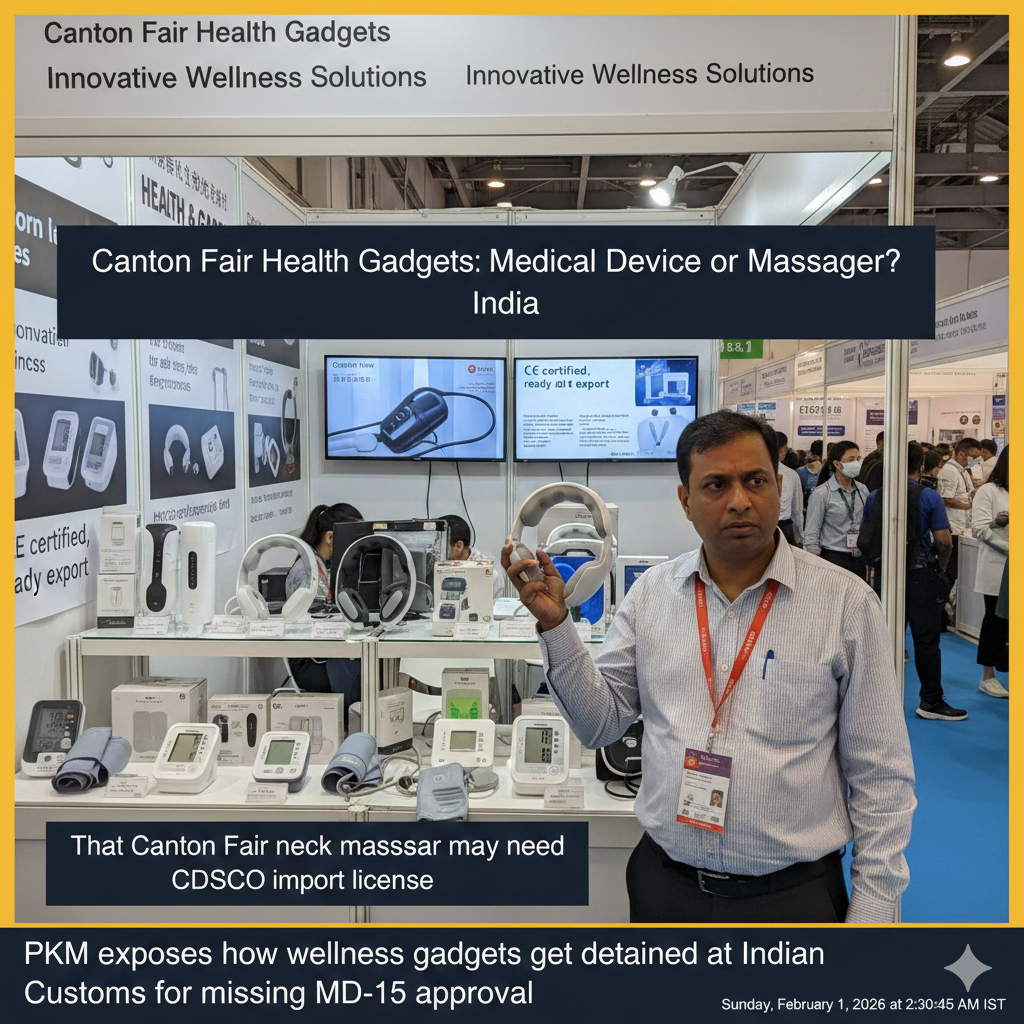
The Reality Indian Buyers Ignore
You walk through Canton Fair Phase 1 (April 15-19 / October 15-19), where Hall 10.2 and 11.2 explode with “innovative wellness solutions.” Infrared neck massagers. Portable thermometers. Blood pressure monitors. Pulse oximeters. Electronic muscle stimulators. UV sterilizers marketed as “health tech.”
The Chinese supplier’s catalog says: “CE certified, ready to export.”
Your purchase order is placed. The container ships. You’re already planning your product launch.
Then your Customs Broker calls from Nhava Sheva or ICD Tughlakabad:
“Your ‘massager’ has been classified as a Medical Device. Where is your CDSCO Import License?”
You don’t have one. You didn’t know you needed one.
Your cargo is now detained. The clock on demurrage has started.
Canton Fair Phase 1: Where ‘Wellness’ Becomes ‘Medical’ Under Indian Law
Typical Product Categories Sourced:
- Electric massagers (neck, foot, handheld, percussion guns)
- Digital thermometers (infrared, contactless)
- Blood glucose monitors
- Blood pressure monitors (automatic, wrist, arm)
- Pulse oximeters
- TENS units (Transcutaneous Electrical Nerve Stimulation)
- Red light therapy devices
- UV sterilization boxes
- Nebulizers
- Hot/cold therapy pads with electronic controls
The Compliance Blind Spot:
Indian buyers treat these as “consumer electronics” or “general merchandise.” Chinese suppliers reinforce this by providing:
- CE certificates (irrelevant in India)
- FDA registration numbers (U.S., not India)
- ISO quality certifications (not import clearance documents)
None of these matter at Indian Customs.
What Makes It a ‘Medical Device’ Under Indian Law?
The Medical Devices Rules, 2017 (under Drugs and Cosmetics Act, 1940) define a medical device as:
“Any instrument, apparatus, appliance, implant, material or other article intended by its manufacturer to be used for diagnosis, prevention, monitoring, treatment or alleviation of disease.”
If your product makes any therapeutic claim—even indirectly—it’s a medical device.
Examples That Trap Canton Fair Buyers:
ProductWhat Supplier SaysWhat Indian Law SaysInfrared neck massagerRelaxation deviceMedical Device (pain relief claim)Digital thermometerConsumer electronicsMedical Device (diagnostic purpose)Pulse oximeterFitness tracker accessoryMedical Device (monitors blood oxygen)TENS unitMuscle stimulatorMedical Device (therapeutic use)UV sterilizer boxHome applianceMedical Device if marketed for disinfection of medical tools
If the packaging, label, or product listing mentions:
- “Relieves pain”
- “Improves circulation”
- “Medical-grade accuracy”
- “FDA approved” (even U.S. FDA)
- “Doctor recommended”
It is a medical device in India.
The Indian Import Compliance Structure for Medical Devices
1. Classification Under Medical Devices Rules, 2017
Medical devices in India are classified into four risk-based categories:
- Class A (Low Risk): Tongue depressors, medical gloves
- Class B (Low-Moderate Risk): Syringes, nebulizers, thermometers
- Class C (Moderate-High Risk): Blood pressure monitors, infusion pumps
- Class D (High Risk): Pacemakers, heart valves, surgical implants
Most Canton Fair wellness gadgets fall under Class B or Class C.
2. Mandatory Registrations and Licenses
Before your first shipment lands in India, you need:
A. Medical Device Import License (Form MD-15)
Issued by: State Drug Controller (under CDSCO)
Required for: All medical devices
Processing time: 4-8 weeks (not including errors or queries)
Documents required:
- Form MD-15 application
- Manufacturing license or Free Sale Certificate from country of origin
- Product literature and labeling details
- Authorization letter from foreign manufacturer
- Test reports from NABL-accredited labs (India)
- Undertaking on company letterhead
Without MD-15, your shipment cannot be cleared.
B. Registration Certificate (Form MD-7)
Required for: Class B, C, D devices (most Canton Fair health gadgets)
Issued by: Central Licensing Authority, CDSCO
Processing time: 6-12 months
Documents required:
- Clinical evaluation report
- Risk analysis report
- Quality management system certificate (ISO 13485)
- Declaration of conformity
- Free Sale Certificate
- Test reports as per Indian standards (if applicable)
This is not optional. This is the law.
C. BIS Certification (If Applicable)
Some medical devices also fall under BIS (Bureau of Indian Standards) mandatory certification:
- IS 13450 (Part 1 & Part 2): Medical electrical equipment safety
- IS 15111: Blood pressure monitors (if battery-operated)
If your product has an electrical component and makes a health claim, expect BIS overlap.
3. Labeling and Documentation Requirements
Every medical device imported into India must have:
- Label in English (bilingual allowed, but English mandatory)
- Name and address of Indian importer
- Manufacturing license number
- Batch number and manufacturing date
- Expiry date (if applicable)
- “Medical Device” declaration
- Instructions for use (in English)
- Adverse event reporting details
If your Chinese supplier pre-prints labels without Indian compliance details, the entire consignment is non-compliant.
What Actually Happens at Indian Ports: The PKM Reality Check
At Premji Kanji Masani Private Limited (PKM), we clear sensitive medical devices—IV sets, cannulas, surgical instruments—every week. We’ve handled Canton Fair shipments for 60+ years. Here’s what we see repeatedly:
Scenario 1: The ‘Massager’ That Wasn’t
Product: 500 units of rechargeable percussion massage guns
Supplier claim: “Sports recovery tool, CE certified”
Indian Customs classification: Medical Device (therapeutic muscle stimulation)
Importer’s status: No MD-15, no CDSCO registration
Outcome:
- Cargo detained at ICD Patparganj, Delhi
- Notice issued: “Submit Medical Device Import License within 7 days”
- Importer cannot produce license (never applied)
- Container demurrage: ₹8,000/day
- Total detention: 23 days
- Demurrage cost: ₹1,84,000
- Customs penalty: ₹50,000
- Options given: Re-export or destroy
The importer re-exported. Total loss: ₹6.2 lakh (including freight, duties deposited, and demurrage).
Scenario 2: The Thermometer Trap
Product: 2,000 infrared contactless thermometers
Supplier claim: “Consumer-grade, plug-and-play”
Indian requirement: Class B Medical Device + BIS (if battery-powered)
What the importer had:
- Commercial invoice
- Packing list
- CE certificate (Europe)
- FDA listing (U.S.)
What the importer needed:
- MD-15 Import License
- MD-7 Registration (if repeat imports planned)
- Test report from NABL lab in India
- Free Sale Certificate from China
- Label compliance with Medical Device Rules
Outcome:
- Cargo held at Nhava Sheva for 19 days
- CDSCO sample drawn for testing (₹35,000 testing cost)
- Test failed: labels non-compliant (no Indian importer address)
- Entire consignment rejected
- Re-labeling not allowed (medical devices cannot be repackaged at port)
The shipment was destroyed under Customs supervision. Total loss: ₹14.8 lakh.
Scenario 3: The Blood Pressure Monitor Fiasco
Product: 300 automatic wrist blood pressure monitors
Intended use: Retail sale on e-commerce platforms
Indian classification: Class C Medical Device
What happened:
- Importer assumed it was “electronics” (like a smartwatch)
- Filed Bill of Entry under HS Code 9018 (medical instruments)
- Customs identified product as medical device
- Asked for MD-15 and MD-7
- Importer had neither
- ADC (Additional Deputy Commissioner) issued notice
- Importer tried to change classification to “toys” (rejected immediately)
Outcome:
- 31-day detention at Chennai Port
- Container detention + demurrage: ₹2.47 lakh
- Forced to abandon shipment
- Customs confiscated and auctioned goods
Total loss: ₹9.6 lakh.
The Top 5 Canton Fair Mistakes with Health & Wellness Gadgets
Mistake 1: Believing “CE = Global Clearance”
CE certification is for the European market. It has zero legal standing in India. Indian Customs will not accept CE in lieu of CDSCO approval.
Mistake 2: Assuming “Massager” ≠ Medical Device
If the product claims to:
- Relieve pain
- Improve blood circulation
- Aid muscle recovery
- Provide therapeutic benefit
It is a medical device. Period.
Mistake 3: Relying on Supplier’s “Documentation Support”
Chinese suppliers will offer:
- Test reports (from Chinese labs—not valid in India)
- Certificates of compliance (to Chinese or U.S. standards)
- Authorization letters (legally meaningless without Indian registration)
None of these replace MD-15 or MD-7.
Mistake 4: “Test Importing” 50 Units to Avoid Compliance
There is no compliance exemption for small quantities.
Even one piece requires:
- Correct HS Code classification
- MD-15 Import License (if medical device)
- Labeling compliance
- Port-of-origin certificates
Small consignments face the same scrutiny—and often more, because they’re flagged as suspicious.
Mistake 5: Waiting Until the Shipment Arrives
You cannot fix medical device compliance at the port.
By the time your Customs Broker informs you of the problem:
- The container is already in India
- Demurrage is accruing daily
- CDSCO will not issue retrospective licenses
- Re-export or destruction are your only options
What PKM Does Before You Place the Canton Fair Purchase Order
At Premji Kanji Masani Private Limited, we don’t wait for your cargo to arrive. We intervene at the sourcing stage.
Pre-Shipment Advisory Checklist (Health & Wellness Products)
Step 1: Product Classification
We examine:
- Product description and claims
- Intended use (consumer vs. therapeutic)
- Presence of diagnostic/monitoring functions
- Electrical safety requirements
We determine: Is this a medical device under Indian law?
Step 2: Compliance Roadmap
If medical device:
- Identify risk class (A / B / C / D)
- List required licenses (MD-15, MD-7)
- Check if BIS overlap exists
- Verify if WPC approval needed (for Bluetooth/wireless models)
- Confirm HS Code and applicable duty structure
Step 3: Supplier Verification
We ask your supplier to provide:
- Manufacturing license (China)
- Free Sale Certificate (authenticated)
- ISO 13485 certification (quality management for medical devices)
- Product test reports (electrical safety, biocompatibility if skin contact)
- Labeling mock-up (we check compliance before printing)
If the supplier cannot provide these, we recommend not placing the order.
Step 4: Documentation Timeline
We map out:
- MD-15 application: 4-8 weeks
- MD-7 registration (if applicable): 6-12 months
- BIS certification (if needed): 8-12 weeks
- WPC approval (if wireless): 4-6 weeks
We tell you: “Do not ship until these are in hand.”
Step 5: Labeling and Packaging Pre-Clearance
We review:
- English labeling (mandatory)
- Indian importer details on each unit
- Batch number, MRP (if retail), expiry (if applicable)
- Instruction manual compliance
- Packaging material (no wood pallets without fumigation)
We ensure labels are India-ready before your supplier prints 5,000 boxes.
The Pre-Canton Fair Compliance Checklist for Indian Buyers
Before You Visit Canton Fair Phase 1:
1. Define Product Intent
- Will this product make any health-related claim?
- Does it diagnose, monitor, or treat any condition?
- Does it touch the human body for therapeutic purposes?
If yes to any: It’s a medical device.
2. Identify Applicable Regulations
For health & wellness gadgets, expect overlap:
- CDSCO (Medical Devices Rules, 2017)
- BIS (electrical safety standards)
- WPC (if Bluetooth, Wi-Fi, or wireless)
- EPR (if electronic waste applicable)
3. Questions to Ask Your Canton Fair Supplier
Do not leave the booth without answers:
- Do you have ISO 13485 certification?
- Can you provide a Free Sale Certificate from China?
- Can you share the full product test report (electrical safety, EMC)?
- Are you willing to modify labeling for Indian compliance?
- What is your lead time for documentation (not just production)?
- Have you exported this product to India before? (Ask for reference)
4. Consult a Licensed Customs Broker BEFORE Placing Orders
Do not wait until the proforma invoice is signed.
Contact your Customs Broker with:
- Product brochure
- Supplier’s compliance documents
- Your intended import quantity
- Target India launch timeline
We will tell you:
- Exact licenses required
- Realistic timeline (including documentation delays)
- Estimated landed cost (duties + compliance + testing)
- Whether the product is viable for India at all
What Happens If You Ignore This Advice
Based on 60 years at Indian ports, here’s the inevitable outcome:
Week 1: Your container arrives at Nhava Sheva / Mundra / Chennai
Week 2: Customs issues a notice—”Submit MD-15 within 7 days”
Week 3: You scramble to apply for MD-15 (but processing takes 6-8 weeks)
Week 4: Demurrage crosses ₹1 lakh
Week 5: You try to get exemption / provisional clearance (denied)
Week 6: CDSCO samples your goods for testing (₹30,000-50,000 cost)
Week 8: Test fails (non-compliant labeling)
Week 9: Customs gives final notice—re-export or destroy
Week 10: You re-export or destroy. You lose everything.
This is not a worst-case scenario. This is the standard scenario.
Why ‘Wellness Gadgets’ Are High-Risk Imports from Canton Fair
1. Supplier Ignorance of Indian Law
Chinese manufacturers design for:
- U.S. FDA requirements
- European CE marking
- General consumer electronics standards
They have no understanding of:
- CDSCO medical device classification
- Indian labeling mandates
- State Drug Controller licensing
- NABL lab testing requirements
They will confidently tell you: “We export globally, no problem.”
They are wrong.
2. Product Claims Create Legal Risk
Marketing language used at Canton Fair:
- “Medical-grade accuracy”
- “FDA approved” (U.S., not India)
- “Clinically tested”
- “Doctor recommended”
Every single one of these statements triggers Medical Device classification in India.
Even if you plan to market it as a “general wellness product” in India, if the original packaging or supplier’s literature contains therapeutic claims, Customs will classify it as a medical device.
3. E-Commerce Platforms Will Reject Non-Compliant Devices
Amazon India, Flipkart, and other platforms now require:
- MD-15 upload (for medical devices)
- BIS registration certificate (if applicable)
- Product liability insurance (for therapeutic devices)
If you bypass Customs by undervaluing or misdeclaring, you will still be caught when trying to sell online.
4. Post-Import Legal Liability
If your product:
- Causes harm to a consumer
- Is found non-compliant in a market survey
- Triggers a CDSCO inspection
You (the importer) are legally liable under:
- Drugs and Cosmetics Act, 1940
- Consumer Protection Act, 2019
- Legal Metrology Act (if MRP-related violations)
Penalties include:
- Imprisonment up to 3 years
- Fines up to ₹10 lakh
- Product recall at your cost
- Business license suspension
PKM’s Final Word: The Canton Fair Does Not Prepare You for Indian Customs
The Canton Fair is a sourcing event. It is not a compliance workshop.
Your supplier will give you:
- Product catalogs
- Price lists
- CE certificates
- Promises of “full documentation support”
Your supplier will not give you:
- MD-15 Import License
- MD-7 Registration Certificate
- NABL test reports from India
- Labels compliant with Indian law
Because they cannot. Only you (or your licensed Customs Broker) can obtain these.
At Premji Kanji Masani Private Limited, we clear IV sets, cannulas, surgical instruments, and diagnostic devices every month. We know exactly where Canton Fair wellness gadgets go wrong at Indian ports.
We handle sensitive medical imports because we:
- Understand CDSCO classifications (not just HS Codes)
- Coordinate with State Drug Controllers before shipment
- Ensure labeling compliance before your supplier prints 10,000 units
- Plan import timelines around documentation lead times (not just shipping lead times)
- Know when a “massager” will be classified as a medical device—before you place the order
What You Should Do Right Now
If You Haven’t Attended Canton Fair Yet:
Do not finalize any health/wellness gadget order without:
- Confirming product classification (medical device or not)
- Checking supplier’s ISO 13485 and Free Sale Certificate
- Consulting a licensed Customs Broker on compliance roadmap
- Budgeting for MD-15, testing, and compliance timelines (add 3-4 months to your plan)
If You’ve Already Placed an Order:
Contact your Customs Broker immediately with:
- Product details and brochure
- Supplier’s documentation
- Expected shipment timeline
We will:
- Assess classification risk
- Identify missing licenses
- Apply for MD-15 if eligible
- Coordinate pre-shipment testing (if time permits)
- Advise on label corrections before printing
If Your Shipment Is Already on the Way:
Do not wait for the container to arrive.
Share with your Customs Broker:
- Bill of Lading
- Commercial Invoice
- Packing List
- Any compliance documents supplier provided
We will:
- Pre-assess detention risk
- Prepare for CDSCO sampling
- Advise on contingency (re-export / destruction) if non-compliant
- Minimize demurrage exposure
The PKM Difference: 60 Years of Keeping Canton Fair Cargo Moving
Since 1963, Premji Kanji Masani Private Limited has cleared shipments from every Canton Fair phase.
We’ve seen:
- “Massage chairs” classified as medical devices
- “Fitness trackers” rejected for missing WPC approval
- “Wellness lamps” detained for BIS non-compliance
- “Thermometers” destroyed for labeling violations
We don’t let our clients learn compliance through cargo detention.
We intervene before the purchase order.
We clear the path before the shipment sails.
We protect your investment before it becomes a Customs penalty.
Clearing Your Cargo, Retaining Your Trust, Since 1963.
Pre-Shipment Advisory for Canton Fair Health & Wellness Imports
Before you finalize your Canton Fair order, consult PKM.
We will provide:
- Product classification assessment (medical device vs. general goods)
- Compliance roadmap (CDSCO, BIS, WPC)
- Documentation checklist tailored to your product
- Realistic timeline (including license processing)
- Cost estimate (duties + compliance + testing)
We will not:
- Sell you services you don’t need
- Encourage you to import non-compliant products
- Promise shortcuts that don’t exist
Contact Premji Kanji Masani Private Limited today.
Because the Canton Fair ends in 5 days.
But Indian Customs never closes.


