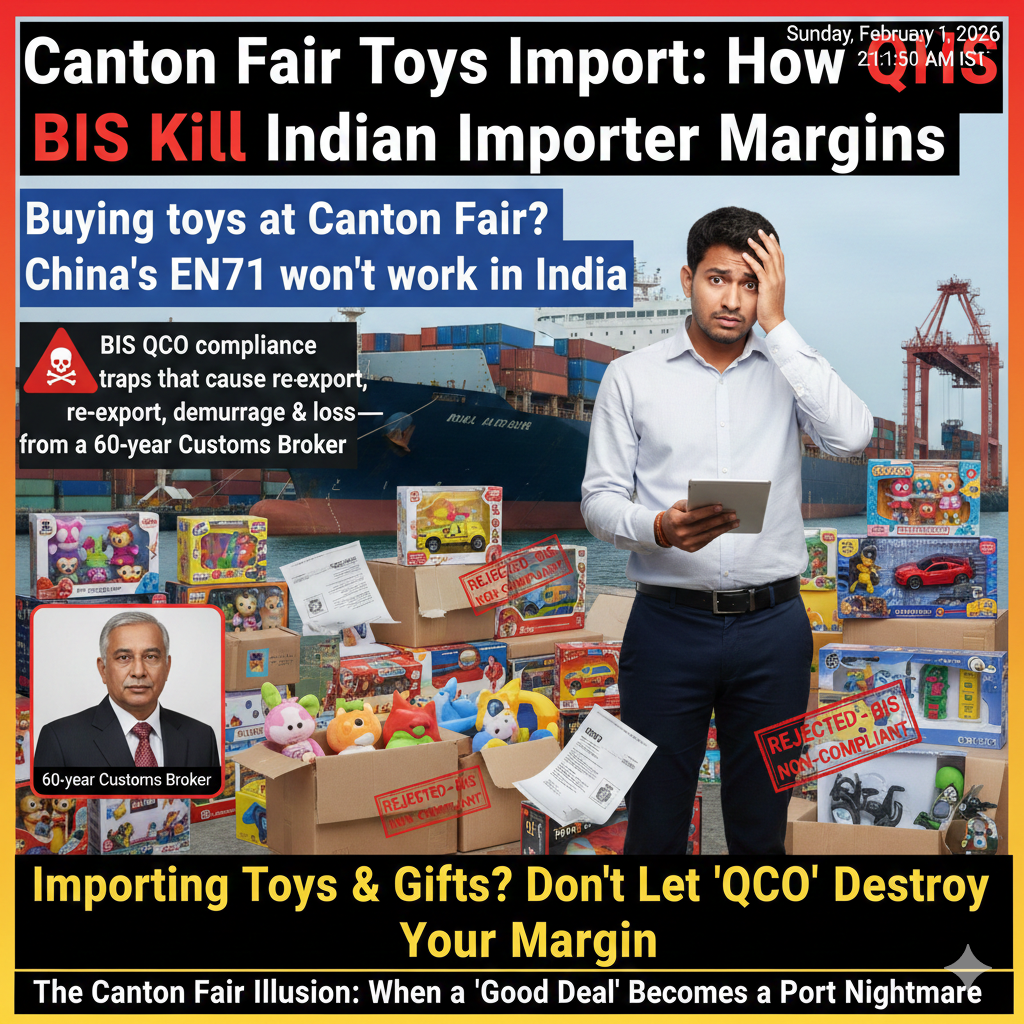
The Canton Fair Illusion: When a “Good Deal” Becomes a Port Nightmare
You walk through Hall 1.1 or 2.1 at the Canton Fair Phase 3 (typically late April or late October), surrounded by colorful plush toys, remote-controlled cars, educational puzzles, battery-operated dinosaurs, and gift sets that would fly off Indian shelves during Diwali or Christmas. The Chinese supplier quotes you FOB prices that promise 60% margins. The samples look perfect. You shake hands, pay the advance, and return to India confident you’ve cracked the toy business.
Three months later, your container lands at Nhava Sheva. The Customs Broker calls: “Sir, toys are under QCO. BIS license missing. Container cannot be cleared.”
What follows is not a business setback—it’s financial carnage.
This is not a rare story. This is the standard outcome for Canton Fair toy buyers who ignore Indian law at the sourcing stage.
At Premji Kanji Masani Private Limited (PKM), we have been clearing cargo at Indian ports since 1963. In the last three years alone, we have witnessed over 40 toy consignments either abandoned, re-exported, or destroyed—not because of Customs duty disputes, but because of a single compliance failure: no valid BIS license under India’s Quality Control Order (QCO) for toys.
Let us be direct: Chinese toys are attractive. India’s Quality Control Orders are stricter. And the Canton Fair does absolutely nothing to prepare you for the latter.
Phase 3 Canton Fair: Where Indian Toy Importers Make the Fatal Mistake
Canton Fair Phase 3 focuses heavily on:
- Toys & Games (Halls 1.1, 2.1)
- Gifts, Decorations & Festive Items
- Baby Products & Educational Toys
- Outdoor Recreation Products
- Stationery & School Supplies
This is prime hunting ground for Indian SMEs entering e-commerce, retail chains, or festive wholesale. But it’s also where compliance ignorance costs the most.
Here’s what typically happens:
- You find a supplier manufacturing soft toys, electric ride-on cars, or STEM kits.
- The supplier shows you CE certification or EN71 test reports (European toy safety standards).
- You assume these certificates will work in India.
- You place your order based on price, MOQ, and delivery time.
- You never ask about BIS certification.
Result: Your shipment becomes legally non-importable the moment it arrives in India.
What Is QCO? And Why Does It Destroy Margins?
Quality Control Order (QCO) – India’s Import Gate for Toys
Since June 2020, the Government of India enforced a mandatory Quality Control Order (QCO) under the Bureau of Indian Standards (BIS) Act for toys. Amended multiple times (most recently in 2023), the QCO now covers:
- Soft Toys (plush, stuffed animals, dolls)
- Plastic Toys (action figures, building blocks)
- Electric/Electronic Toys (battery-operated cars, remote controls, LED toys)
- Mechanical Toys (wind-up toys, pull-along)
- Wooden Toys, Puzzles, Board Games
- Ride-on Toys (tricycles, scooters, electric cars)
- Outdoor Play Equipment (swings, slides, activity sets)
Legal Requirement: Every toy imported into India must carry a valid BIS license (ISI Mark), issued to the manufacturer (Chinese factory) after factory audit and product testing as per IS 9873 (Part 1 to Part 9) and IS 15644.
No BIS License = No Import Clearance.
This is not a “guideline.” This is a legal ban.
The Expert Insight: What We See at Indian Ports
“We frequently see importers buy Soft Toys, Electric Cars, or Puzzles at Canton Fair. Since 2021, BIS certification is mandatory for toys. A simple ‘EN71’ certificate from the supplier is useless in India. You need a BIS License (ISI Mark) granted to the Chinese factory. If they don’t have it, do not buy. We have seen full containers re-exported because of this single oversight.”
— Senior Customs Clearance Manager, PKM (45 years at Mumbai ports)
Let us break down what “re-export” actually means in cost terms:Cost HeadTypical Amount (20ft Container)Demurrage (port storage)₹15,000 – ₹25,000 per dayContainer Detention₹8,000 – ₹12,000 per dayCustoms Penalty (if applicable)₹50,000 – ₹2,00,000Re-export freight$800 – $1,500 USDDetention at Chinese port (if unclaimed)Additional $500+Lost product value100% of FOB + freight paid
Total Loss Window: ₹5 lakh to ₹15 lakh on a single container, depending on dwell time.
Timeline: 30–90 days of legal and logistical limbo.
Outcome: Product never sold. Money never recovered.
Top Import Mistakes Indian Buyers Make at Canton Fair (Toys & Gifts)
Mistake #1: Accepting CE or EN71 as “International Certification”
Chinese suppliers will gladly show you CE marks (Europe), ASTM F963 (USA), or EN71 (EU toy safety). These mean nothing in India.
Indian law recognizes only BIS certification under IS 9873 standards.
Mistake #2: Assuming the Supplier “Will Arrange BIS”
Many suppliers say, “Don’t worry, we can get BIS after you order.”
Reality: BIS certification requires:
- Factory inspection in China by BIS-empaneled agencies
- Product testing at NABL-accredited labs
- 3–6 months processing time
- Significant cost (often $3,000–$8,000 per product category)
If the factory doesn’t already have BIS for your exact product, you cannot import it legally—period.
Mistake #3: Ordering “Samples” Without Compliance Check
You bring back 10 samples by air courier. Customs may let them in under “personal use” or “R&D.” You test the market. It works. You order 5,000 units.
Then the commercial consignment hits the port—and gets stopped.
Samples ≠ compliance clearance.
Mistake #4: Ignoring Labeling & Packaging Requirements
Even if you have BIS, Indian law mandates specific labeling:
- BIS License Number & ISI Mark on every product/package
- Importer name, address, and contact details
- “Not suitable for children under 3 years” warnings (if applicable)
- Country of origin: “Made in China”
- MRP (Maximum Retail Price) under Legal Metrology Act
Missing any of these = detention, not just a warning.
Mistake #5: Buying Lithium Battery Toys Without WPC Approval
Remote-controlled cars, LED toys, Bluetooth-enabled products, or anything with wireless transmission also need WPC (Wireless Planning & Commission) approval in addition to BIS.
Battery-powered toys with lithium cells need additional compliance under Battery Waste Management Rules.
One product. Three compliance regimes. All mandatory.
What Actually Happens at Indian Ports When BIS Is Missing
Let’s walk through a real scenario we handled in Q4 2023:
Client: First-time importer from Surat
Product: 3,000 pcs battery-operated toy cars (Canton Fair Phase 3 purchase)
Mistake: Supplier provided EN71. Client assumed it was sufficient.
Port: Mundra
Outcome:
- Day 1–7: Customs issues detention notice under Section 111(d) of Customs Act. Importer given 7 days to produce BIS license.
- Day 8–14: Importer scrambles. Supplier in China says “BIS will take 4 months.” Goods stuck.
- Day 15–30: Demurrage piles up. ₹18,000/day. Now ₹2.7 lakh.
- Day 31: Customs offers three options:
- Re-export (importer pays freight + detention)
- Destroy under Customs supervision (importer pays destruction + storage)
- Abandon (forfeiture to government; importer loses everything)
Client chose re-export. Total loss: ₹9.2 lakh.
This was avoidable with one question at Canton Fair: “Do you have a valid BIS license for India?”
BIS Certification for Toys: What Canton Fair Suppliers Won’t Tell You
How BIS Certification Actually Works
- Application: Chinese manufacturer applies to BIS (not the Indian importer).
- Testing: Product tested at BIS-recognized lab (in China or India) for IS 9873 standards.
- Factory Inspection: BIS-approved agency inspects the Chinese factory.
- License Issued: Valid for 1–2 years. Renewable.
- Marking: Every toy must display the BIS license number and ISI mark.
Critical Point: The Chinese factory is the license holder, not you. If the factory doesn’t have BIS already, you cannot legally import until they obtain it—regardless of how attractive the price is.
What to Ask Your Canton Fair Supplier (Before Placing Order)
QuestionWhat You’re Actually Checking“Do you have BIS certification for India?”Whether they’ve ever exported to India legally”Can I see your BIS license number and certificate?”Proof, not promises”Is the BIS license valid for this specific product?”Some factories have BIS for plastic toys but not electric ones”Will you print the BIS mark and license number on the product/packaging?”Compliance at manufacturing stage”Do you have WPC approval if the toy has wireless/Bluetooth features?”Dual compliance check
If the answer to any of these is vague, delayed, or “we’ll arrange it later”—walk away.
PKM Practical Insight: How Experienced Customs Brokers Prevent This Disaster
At PKM, we don’t just clear cargo. We prevent non-clearable cargo from ever being shipped.
Our Pre-Shipment Advisory Process for Canton Fair Toy Buyers:
Before You Go to Canton Fair
- Identify product categories you want to source
- We provide a Compliance Checklist for each category (BIS, FSSAI, CDSCO, WPC, etc.)
- You know exactly what certificates to demand from suppliers
At Canton Fair
- Verify supplier’s BIS license on the spot (we can help cross-check remotely)
- Ask for ISI mark placement proof (photos of actual products with marking)
- Get written confirmation that packaging will comply with Indian labeling laws
Before Shipment
- Share product details, supplier BIS certificate, and packaging samples with us
- We cross-verify with BIS database and DGFT regulations
- If something is missing, we flag it before you make payment or ship
At Port of Arrival
- If compliance is pre-confirmed, clearance is smooth
- If surprise issues arise (it happens), we have the documentation to defend or re-route
This approach has saved our clients ₹2.3 crore+ in potential losses over the last 18 months alone.
The Real Cost of “Figuring It Out Later”
Many Canton Fair buyers operate on this logic:
“Let me import a small trial order first. If it gets stuck, I’ll deal with it.”
Here’s why that logic bankrupts businesses:
- Demurrage doesn’t care about trial orders. ₹15,000/day applies to 100 units or 10,000 units.
- Re-export freight is the same whether your cargo is worth ₹50,000 or ₹5 lakh.
- Your reputation with Customs suffers. Future consignments face heightened scrutiny.
- You lose the festive/seasonal window. Toys ordered in May for Diwali, stuck at port in September = zero revenue.
The margin you thought you’d make? It’s now funding the shipping line’s detention charges.
Pre-Canton Fair Compliance Checklist for Indian Toy Importers
30 Days Before Canton Fair
- Confirm product categories you’re sourcing (soft toys, electric toys, puzzles, etc.)
- Check if they fall under QCO (assume yes for all toys)
- Consult your Customs Broker (PKM or equivalent) for compliance requirements
- Prepare list of questions for suppliers regarding BIS
At Canton Fair
- Ask for BIS license certificate (verify license number on BIS website if possible)
- Request photos of ISI mark placement on actual products
- Confirm supplier can print importer details and MRP on packaging
- For battery/electronic toys: ask about WPC approval
- Get written commitment on compliance in Purchase Order
Before Making Payment
- Share supplier’s BIS certificate with your Customs Broker for verification
- Confirm labeling and packaging mock-ups comply with Legal Metrology Act
- Verify product description in invoice matches BIS license scope
Before Shipment
- Ensure BIS mark is printed/affixed on products
- Confirm all labeling (importer name, MRP, warnings) is in place
- Get pre-shipment inspection report if possible
Post-Shipment / Pre-Arrival
- Share all compliance documents with Customs Broker
- Prepare Bill of Entry documents
- Have BIS license, test reports, and supplier declarations ready for Customs
Why “QCO” Is the Silent Margin Killer
The word “QCO” doesn’t appear in Canton Fair catalogs. Chinese suppliers don’t mention it. Your margins look brilliant on the negotiation table.
Then QCO enforcement hits at the Indian port—and your margin becomes your loss.
This is not about Customs being difficult. This is about Indian law protecting consumers from substandard or unsafe toys. The law exists. The enforcement is real. And ignorance is not a defense.
At PKM, we’ve seen:
- Electric toy cars re-exported because BIS was missing
- Soft toys destroyed because labeling didn’t comply
- Educational puzzles detained for 60+ days because the supplier’s BIS license had expired
- ₹12 lakh worth of festive gift sets abandoned because no one asked about QCO
Every single case was avoidable.
The PKM Difference: Clearing Your Cargo, Retaining Your Trust, Since 1963
We are not consultants who guess. We are practitioners who clear.
Premji Kanji Masani Private Limited has been a licensed Customs Broker for over 60 years. We have cleared toys, electronics, machinery, food, chemicals, and everything in between. We’ve seen every compliance trap. We’ve fought every unreasonable detention. And we’ve saved our clients from every avoidable mistake.
Our job is not to clear your cargo after it arrives. Our job is to make sure it’s clearable before it ships.
Final Word: Canton Fair Is Not a Compliance Event
The Canton Fair is a sourcing event. It is designed to connect buyers and sellers. It is not designed to educate Indian importers about BIS, QCO, FSSAI, CDSCO, WPC, or any other Indian compliance regime.
That education is your responsibility. And the cost of ignoring it is yours to bear.
If you are planning to source toys, gifts, or any other product at Canton Fair, do not wait until your cargo is at the port to learn about Indian law.
Talk to a Customs Broker before you negotiate. Verify compliance before you pay. Confirm documentation before you ship.
Or prepare to pay demurrage, re-export freight, and penalties while your competitors sell the same products legally.
Pre-Shipment Advisory: Protect Your Investment Before It Sails
If you’re attending Canton Fair Phase 3 (or any phase), and you’re sourcing toys, gifts, electronics, or consumer goods, reach out to PKM for a Pre-Shipment Compliance Review.
We’ll tell you:
- What certifications you actually need (not what the supplier claims)
- What labeling and packaging must be in place
- What risks exist at Indian ports for your specific products
- How to structure your Purchase Order to protect yourself legally
This is not a sales pitch. This is a survival strategy.
Because in the import business, the best clearance is the one that never faces a problem.
Premji Kanji Masani Private Limited
Licensed Customs Broker | Clearing Your Cargo, Retaining Your Trust, Since 1963


