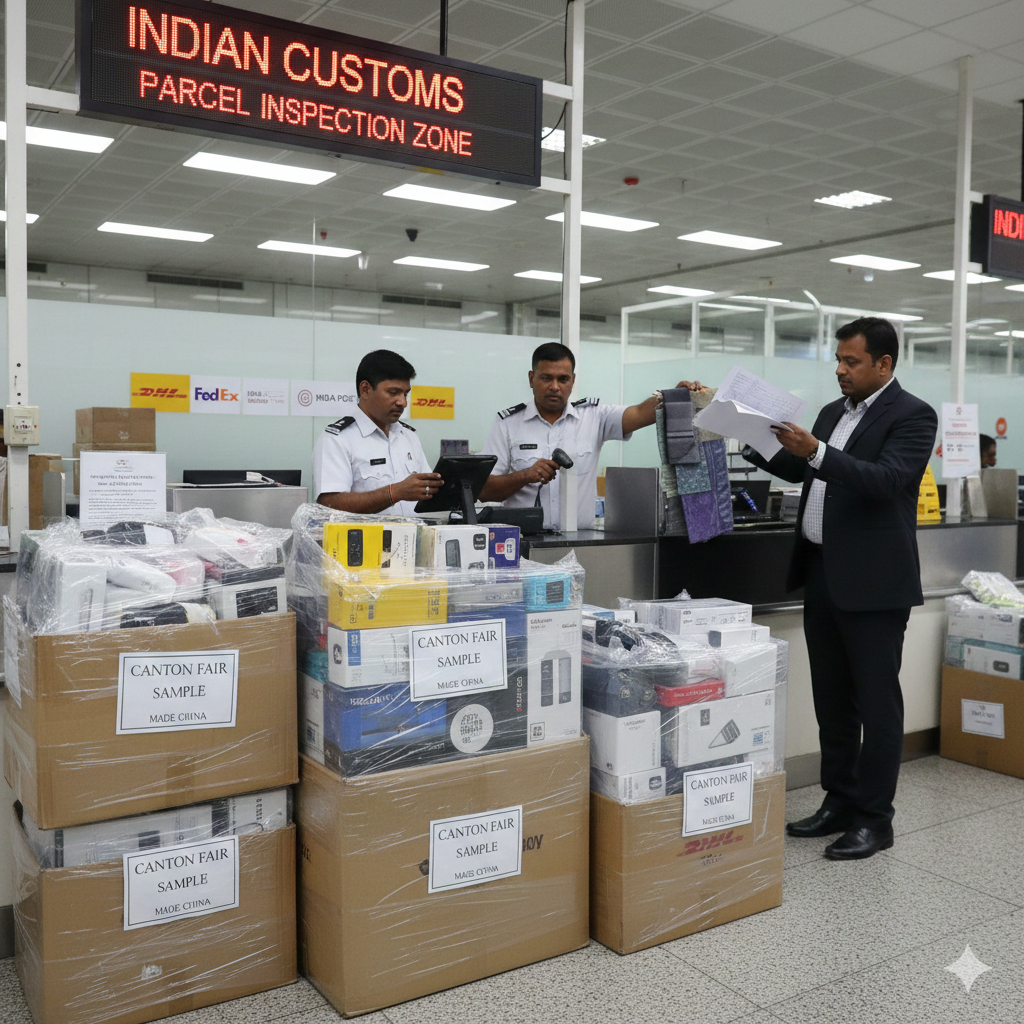
The Reality Check Indian Importers Refuse to Hear
You’ve booked your Canton Fair tickets. You’ve shortlisted suppliers. You’re planning to bring back “samples” in your suitcase or ship them via DHL to “test the market.”
Here’s what 60 years at Indian ports has taught us: The Indian Customs Act does not recognize your good intentions.
A “sample” shipment whether it arrives in your baggage, via FedEx, or as a single carton marked “Not for Sale” is still a commercial import under Indian law. And if that sample is a cosmetic, an electronic device, a chemical, a medical product, or even a toy, it triggers the same compliance rules as a 40-foot container.
Most Canton Fair buyers learn this lesson at the courier clearance office — not at the fair.
At Premji Kanji Masani Private Limited (PKM), we’ve seen Indian entrepreneurs wait 90+ days for a single courier package containing “just samples” because they assumed compliance starts only when you import “in bulk.”
It doesn’t.
Canton Fair Phase Context: When “Samples” Become a Trap
Phase 1 (Electronics, Machinery, Hardware)
Typical products sourced: LED lights, power banks, smart devices, kitchen appliances, tools, gadgets
The sample trap: Buyers collect samples of electronic items, ship them via courier, and discover at clearance that:
- WPC (Wireless Planning & Commission) approval is mandatory for Bluetooth/Wi-Fi products
- BIS registration is required for notified electronics (chargers, adapters, LEDs)
- A single power bank without BIS marking = detention + penalty
Phase 2 (Consumer Goods, Gifts, Home Décor)
Typical products sourced: Kitchenware, stationery, toys, beauty tools, home textiles
The sample trap: A toy sample, a cosmetic brush set, or a “test order” of 50 pieces via air courier triggers:
- BIS for toys (mandatory registration)
- Quality Control Orders (QCO) for certain consumer goods
- Labeling rules under Legal Metrology Act (if the sample has “price printed” or “quantity marked”)
Phase 3 (Textiles, Garments, Fabrics, Footwear)
Typical products sourced: Ready-made garments, fabric rolls, shoes, bags
The sample trap: Textile samples often escape scrutiny, but:
- If the sample contains prohibited azo dyes, even 1 meter can be detained
- Footwear samples may require BIS registration (especially safety shoes)
- “Sample labeling” doesn’t exempt you from Legal Metrology rules if the item bears MRP
Top 5 “Sample Shipment” Mistakes Made at Canton Fair
Mistake #1: Assuming “Samples” Are Exempt from Compliance
Reality: Indian Customs classifies goods by nature, not by intent. If the product category is notified under BIS, FSSAI, CDSCO, or WPC, compliance applies — even for 1 unit.
Example: A cosmetic sample (lipstick, serum) requires CDSCO import license, even if marked “Not for Sale.” Without it, your courier stays at the CFS (Container Freight Station) indefinitely.
Mistake #2: Bringing Samples in Personal Baggage to “Avoid Customs”
Reality: Indian Customs officers at airports are trained to identify commercial samples disguised as personal effects. If you’re carrying:
- Multiple identical items
- Products with company branding or packaging
- Anything that appears “trade-related”
You will be stopped. You will be asked to prove personal use. And if you can’t, you’ll either:
- Pay duty + penalty on the spot
- Abandon the goods
- File a formal Bill of Entry (which most travelers are unprepared to do)
PKM Insight from 6 decades: We’ve assisted clients who spent 8 hours at Mumbai Customs because they tried to bring in “just 5 samples” of skincare products in their suitcase. The Customs officer applied the full CDSCO compliance lens — because legally, he had to.
Mistake #3: Using Courier Mode (FedEx/DHL/UPS) Without Understanding Indian Express Clearance
What most Canton Fair buyers believe: “Courier companies will handle clearance.”
What actually happens:
- DHL/FedEx India will not file compliance documents (BIS certificates, FSSAI licenses, CDSCO NOCs) on your behalf
- They will ask you to provide these documents
- If you don’t have them, your shipment enters customs hold
- You pay demurrage (₹500–₹2,000/day) while scrambling to arrange certificates you didn’t know existed
Real Case (2023): A Pune-based entrepreneur imported 3 Bluetooth speakers via DHL after Canton Fair. Cost: $120. The shipment was held for 62 days because:
- WPC ETA (Equipment Type Approval) was missing
- BIS registration was not done
- The importer assumed “it’s just 3 pieces, how does it matter?”
Total cost to release: ₹1,87,000 (courier charges, demurrage, late penalty, and finally — re-export, because the client gave up).
Mistake #4: Assuming Chinese Suppliers Will Provide “Clearance Documents”
What suppliers at Canton Fair promise: “Yes, we give CE certificate, test report, all documents.”
What Indian Customs needs:
- BIS certificate (issued by BIS India, not a Chinese lab)
- CDSCO import license (issued by Indian Drug Controller, not a Chinese manufacturer)
- WPC ETA (issued by WPC India, not an FCC or CE body)
The disconnect: Chinese suppliers provide documents valid for China or Europe. These are not accepted by Indian Customs for notified categories.
PKM has seen this exact scenario 1,000+ times: The Indian importer lands in India with a courier tracking number and a “test report” from a Guangzhou lab. Indian Customs asks for BIS. The importer has nothing. Detention begins.
Mistake #5: Not Filing a Bill of Entry for “Samples”
The legal position: Under the Customs Act, 1962, every import into India requires a Bill of Entry — even if it’s a free sample, even if it’s worth ₹500.
What most importers do: They tick “personal use” or “gift” on the courier form and hope for leniency.
What Customs does: If the goods are identifiable as commercial samples (branded, packaged, or multiple identical units), Customs mandates a Bill of Entry. You can’t skip this step.
The mess: Without a Bill of Entry, you cannot:
- Claim the goods
- Prove lawful import (for future audits or GST claims)
- Use the sample legally for commercial trials in India
India-Specific Compliance Traps: What Applies to “Sample” Imports
1. BIS (Bureau of Indian Standards)
Applies to: Electronics, toys, helmets, certain chemicals, LED lights, pressure cookers, gas cylinders, and 400+ notified products.
Sample or not: If your product is on the BIS notified list, even 1 piece requires BIS registration before import.
Consequence: Detention, re-testing in India, or re-export. No clearance until BIS certificate is produced.
2. CDSCO (Central Drugs Standard Control Organisation)
Applies to: Cosmetics, drugs, medical devices, surgical instruments, Ayurvedic products.
Sample or not: CDSCO requires an import license for every consignment — including samples.
Consequence: Samples detained. Importer must apply for CDSCO license retrospectively (which takes 30–60 days). Demurrage accumulates.
3. WPC (Wireless Planning & Commission)
Applies to: Any product with Bluetooth, Wi-Fi, radio frequency, GPS, or wireless communication.
Sample or not: WPC ETA is mandatory before import. Even 1 Bluetooth speaker in courier mode will be flagged.
Consequence: Customs will not release the shipment. You must apply for ETA (4–8 weeks process). By then, your “sample” has cost you more than the first bulk order.
4. Legal Metrology (Packaged Commodities Rules)
Applies to: Any pre-packaged product intended for retail sale — even if your “sample” has MRP printed or a label with net weight.
Sample or not: If your sample is packaged as a retail-ready item, Legal Metrology rules apply.
Consequence: Samples can be seized if labeling is non-compliant (missing importer details, incorrect font size, missing month/year of manufacture).
5. EPR (Extended Producer Responsibility)
Applies to: Plastic packaging, batteries, e-waste.
Sample or not: If your sample contains batteries (earbuds, toys, torches), EPR registration may be questioned by Customs.
Consequence: Emerging compliance area. Some ports have started questioning EPR for samples. Inconsistent enforcement, but the risk exists.
What Actually Happens at Indian Courier Clearance (The Timeline No One Warns You About)
Day 1–3: Shipment lands in India (Mumbai, Delhi, Bangalore, Chennai foreign post office or courier hub)
Day 4–7: Courier company notifies you: “Documents required for customs clearance”
Day 8: You realize the Chinese supplier’s CE certificate is useless
Day 10: You contact the supplier. They say, “You need Indian certificate, we don’t have”
Day 15: You Google “BIS registration” and discover it’s a 2–3 month process
Day 20: Demurrage crosses ₹10,000
Day 30: You consult a Customs Broker (like PKM) — but by now, the sample has been at the courier CFS for a month
Day 45: You’re given 3 options:
- Re-export the sample (cost: ₹30,000–₹80,000)
- Destroy it and pay disposal charges (₹15,000–₹40,000)
- Continue fighting with documentation you’ll never get (indefinite demurrage)
Day 60: You give up. Total loss: ₹1.5–₹2 lakhs for “just a sample.”
PKM Practical Insight: How We Prevent This Before Shipment
At Premji Kanji Masani Private Limited, our pre-shipment advisory process has saved clients from exactly this trap — hundreds of times since 1963.
Here’s what we do when an importer contacts us about “bringing samples from Canton Fair”:
Step 1: Product Classification
We identify the HS Code (Harmonized System Code) of the sample. This tells us:
- What compliance applies
- What duty rate applies
- Whether the sample can legally enter India at all
Step 2: Compliance Checklist
We map the product to:
- BIS notified list
- CDSCO schedule
- WPC ETA requirements
- Legal Metrology rules
- Prohibited/restricted import categories
Step 3: Pre-Import Documentation Audit
We ask the client:
- What documents does your Chinese supplier have?
- Are these documents India-compliant?
- If not, what’s the timeline to get India-compliant certificates?
Step 4: Filing Strategy
If the client still wants to import the sample, we advise:
- Whether to use courier or air cargo (courier has stricter limits)
- How to file the Bill of Entry correctly
- What exemptions (if any) apply for R&D or testing samples
- How to declare value to minimize duty while staying compliant
Step 5: Port Liaison
We coordinate with Customs at the arrival port to:
- Pre-clear documentation queries
- Ensure smooth sampling (if testing is required)
- Prevent unnecessary detention
The result: The sample clears in 3–5 days, not 60 days. The client tests the product, decides whether to proceed, and if yes — we handle the bulk import with full compliance from Day 1.
Pre-Canton Fair Checklist for Indian Buyers: What to Verify BEFORE Placing Sample Orders
Use this checklist at the Canton Fair booth itself — not after you’ve shipped the goods.
Before Ordering Samples:
✅ Ask the supplier:
- “Is this product notified under any Indian regulation?”
- “Do you have BIS/CDSCO/WPC/FSSAI certificate for India market?”
- “Can you provide a test report from a NABL-accredited Indian lab?”
If the supplier says “No” or looks confused — do not place the order yet.
✅ Share product details with your Customs Broker:
- Product name, technical specs, material composition
- HS Code (if known)
- Intended use (resale, testing, R&D, display)
- Quantity and mode of shipment (courier, air cargo, baggage)
Let the broker tell you what compliance applies before you commit.
✅ Check if the product is on the prohibited/restricted list: Some items cannot be imported as samples at all:
- Certain chemicals (without CDSCO license)
- Used/refurbished electronics (without special permission)
- Products containing banned substances (azo dyes, phthalates, etc.)
✅ Decide the right import mode:
- Baggage: Only for truly personal-use items (not recommended for commercial samples)
- Courier: Fast but expensive if detained; strict compliance checks
- Air Cargo: Slower but allows proper Bill of Entry filing; better for regulated products
✅ Plan for testing samples (if compliance requires it): For BIS, CDSCO, or FSSAI products, you may need to:
- Send samples to an Indian lab before commercial import
- Get test reports
- Apply for registration
This process takes 60–90 days. Plan accordingly.
The Honest Advisory: When NOT to Import Samples
After 60 years of clearing cargo, we say this with authority:
If you cannot verify compliance before the sample ships — do not import it.
Some Canton Fair buyers get offended by this. They say, “How can I decide without seeing the product first?”
Here’s the truth: You can see the product at the supplier’s booth. You can test the product in China. You can ask for photos, videos, and third-party lab reports.
What you cannot do is import a non-compliant sample into India and expect leniency because “it’s just for testing.”
Indian Customs does not care about your testing plans. They care about compliance. And they will enforce it — on 1 piece or 10,000 pieces.
Final Word: Clearing Your Cargo, Retaining Your Trust — Even for “Just Samples”
At Premji Kanji Masani Private Limited, we’ve been a licensed Customs Broker since 1963. We’ve seen trade policies change, governments change, and import categories expand.
But one thing has remained constant: The importer’s responsibility to comply begins before the first shipment — not after.
Canton Fair is an excellent sourcing platform. But it does not prepare you for Indian import laws. That preparation must happen before you board the flight back to India, not after you receive a detention notice from your courier company.
Pre-Shipment Advisory: What PKM Offers
Before you place any sample order at Canton Fair:
- Share product details with us
- We’ll provide a compliance checklist (BIS, CDSCO, WPC, FSSAI, Legal Metrology)
- We’ll review your supplier’s documentation
- We’ll advise on the correct import mode (courier vs. cargo)
- We’ll file your Bill of Entry correctly
This consultation prevents ₹1–₹2 lakh losses on sample shipments.
It also ensures that when you’re ready to import in bulk — you’re not starting from scratch with compliance.
Contact Premji Kanji Masani Private Limited for pre-Canton Fair compliance advisory.
Clearing Your Cargo. Retaining Your Trust. Since 1963.


