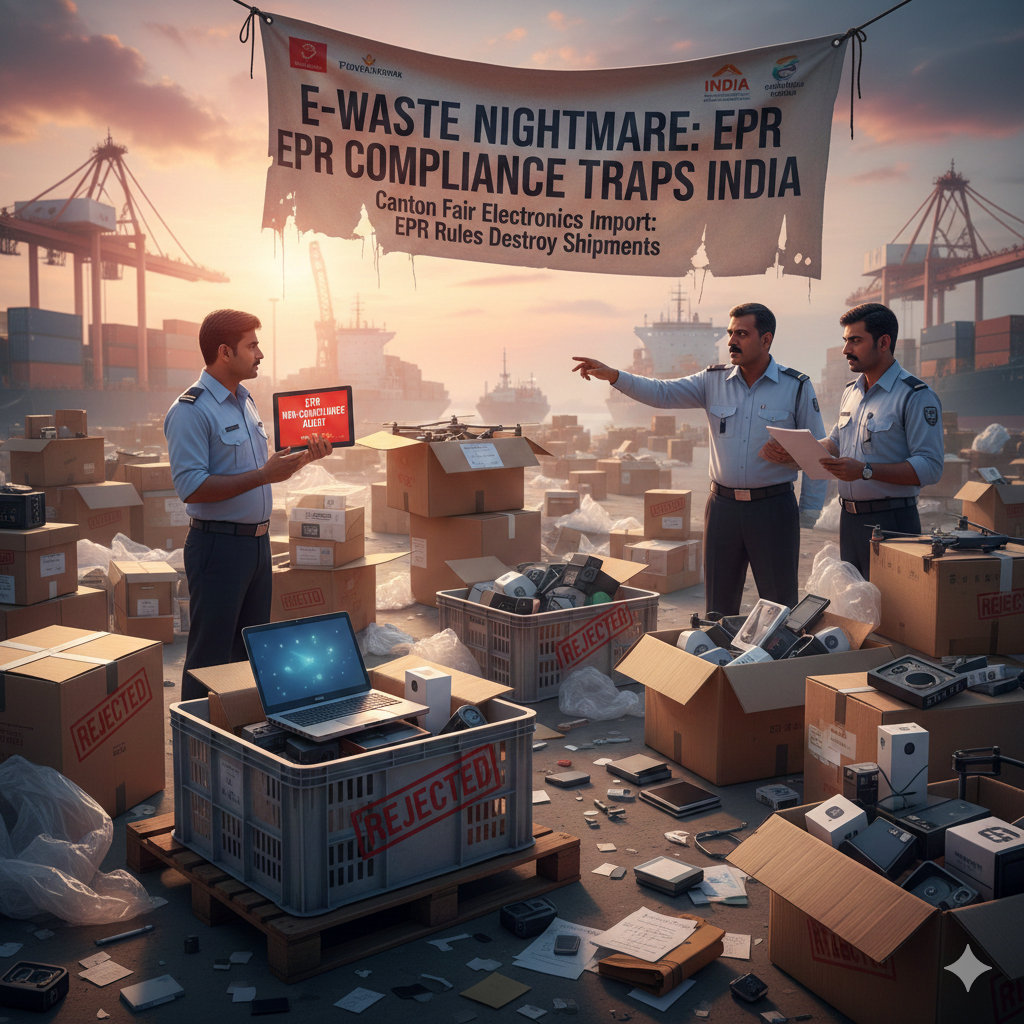
The Canton Fair Illusion: Finding Products Doesn’t Mean You Can Import Them
Every October and April, Indian business owners walk through the Canton Fair’s electronics halls in Guangzhou—Phase 2 and Phase 3—filling notebooks with supplier contacts, product catalogs, and price negotiations. They return convinced they’ve cracked the China sourcing code.
Then the container lands at JNPT or Mundra.
That’s when the nightmare begins.
The sleek consumer electronics, LED lights, Bluetooth speakers, mobile accessories, and IT hardware that looked “ready to sell” in China now face Extended Producer Responsibility (EPR) compliance under India’s E-Waste Management Rules, 2016 and Plastic Waste Management Rules, 2016. Your shipment doesn’t move. Your importer-exporter code gets flagged. Demurrage starts ticking at ₹6,000–₹12,000 per day.
The reality: The Canton Fair does not prepare Indian buyers for Indian environmental compliance laws. Your Chinese supplier has no idea what EPR authorization means. And by the time you’re standing at the CHA office in panic mode, it’s already too late.
At Premji Kanji Masani Private Limited, we’ve been clearing cargo since 1963. In the last five years alone, we’ve seen over 200 electronics consignments detained, sampled, or held indefinitely—not because of valuation disputes or classification errors, but because the importer had zero EPR documentation at the time of import.
This is not a “contact us” sales pitch. This is a compliance warning backed by six decades of port-level reality.
Canton Fair Phase Context: Where Electronics Buyers Get Trapped
Phase 2 (October 23–27 / April 23–27)
Product Categories:
- Consumer electronics
- Household electrical appliances
- Lighting products (LED, smart lights)
- Audio-visual equipment
- Computer peripherals and accessories
Phase 3 (October 31–November 4 / April 27–May 1)
Product Categories:
- Mobile phone accessories
- IT hardware (keyboards, mice, webcams)
- Power banks, chargers, adapters
- Smart wearables
- Office electronics
Common denominator: Every single one of these products falls under E-Waste (Management) Rules, 2016 and most come packaged in plastic—triggering Plastic Waste Management Rules, 2016.
Indian importers at Canton Fair obsess over FOB pricing, MOQ negotiations, and payment terms. Almost none ask about EPR compliance. Almost all pay for it later.
Top Import Mistakes Made at Canton Fair (Electronics & Packaging)
Mistake 1: Assuming “CE Certified” Equals India-Ready
Your Chinese supplier shows you CE certificates, RoHS compliance, and factory audit reports. You assume the product is universally compliant.
Reality: CE is European compliance. India requires EPR authorization under Central Pollution Control Board (CPCB) for electrical and electronic equipment. Without EPR registration, your goods are classified as illegal e-waste at the port of entry.
Mistake 2: Ignoring Plastic Packaging Compliance
You sourced 10,000 Bluetooth speakers. Each unit comes in a plastic blister pack, bubble wrap, and poly bags. You negotiated the product price but never discussed packaging compliance.
Reality: Plastic packaging over 50 microns used for your imported goods requires EPR registration under Plastic Waste Management Rules. Customs will not clear your consignment without proof that you (the importer) or your authorized representative holds valid EPR authorization for plastic packaging waste.
Mistake 3: Believing “First Shipment Is Just a Test”
You’re importing 500 units as a trial. You think compliance can wait until you scale up.
Reality: Indian Customs does not differentiate between “test shipments” and commercial imports. A single carton of mobile chargers triggers the same EPR compliance requirement as a 40-foot container. The law applies from unit one.
Mistake 4: Relying on the Chinese Supplier to “Handle Certificates”
Your supplier promises to “provide all India certificates.” You place the purchase order.
Reality: Chinese manufacturers cannot obtain EPR authorization on your behalf. EPR registration is importer-specificand must be done by an Indian entity or through an authorized Indian representative. Your supplier can provide product test reports, but EPR compliance is your legal responsibility as the importer of record.
Mistake 5: Treating BIS and EPR as the Same Thing
You know certain electronics need BIS (Bureau of Indian Standards) certification. You assume that covers environmental compliance.
Reality: BIS certification ensures product safety and quality standards. EPR compliance ensures you have a waste management plan for the product’s end-of-life disposal. Both are mandatory. Both are separate. Both will block your clearance if missing.
India-Specific Compliance Traps: What Happens at the Port
E-Waste (Management) Rules, 2016 – Electrical & Electronic Equipment (EEE)
Applicable to:
- All electrical and electronic equipment listed in Schedule I of the E-Waste Rules
- Includes: IT equipment, consumer electronics, telecom equipment, lighting equipment, electrical tools, toys with electronic components, medical devices with electronic parts
Mandatory Requirement:
- EPR Authorization from Central Pollution Control Board (CPCB) or State Pollution Control Board (SPCB)
- Authorization must be in the name of the importer (you) or your authorized Indian representative
- Valid for specific product categories and tonnage limits
What Customs Checks:
- EPR authorization certificate number
- Product category alignment with authorization
- Validity period of EPR registration
- Whether the importer’s IEC is linked to the EPR holder
If Missing:
- Detention under Section 111(d) of Customs Act, 1962
- Container remains at CFS (Container Freight Station)
- Demurrage accumulates daily (₹6,000–₹15,000 per day depending on port and container size)
- Options: Re-export at your cost or apply for EPR retrospectively (if allowed)—process takes 45–90 days
- In worst cases: Confiscation and penalty proceedings
Plastic Waste Management Rules, 2016 – Packaging Material
Applicable to:
- All plastic packaging material (including multi-layered plastic) used for your imported goods
- Includes: blister packs, shrink wrap, poly bags, bubble wrap, foam inserts, plastic trays, cling film
Mandatory Requirement:
- EPR registration for plastic packaging waste
- Registration with CPCB under Brand Owner or Importer category
- Annual EPR targets for collection and recycling of plastic waste equivalent to the plastic you import/sell
What Customs Checks:
- EPR certificate for plastic packaging
- Tonnage declared vs. actual packaging weight in shipment
- Validity and category of registration
If Missing:
- Detention notice issued
- Goods held at port pending EPR compliance proof
- Daily storage and demurrage charges apply
- Risk of penalty under Environment (Protection) Act, 1986—up to ₹1,00,000 or imprisonment up to 5 years, or both
The Dual Compliance Trap
Most electronics imported from Canton Fair trigger both E-Waste EPR and Plastic Packaging EPR.
Example: You import 5,000 wireless earbuds.
- Product = Electronic item → E-Waste EPR required
- Packaging = Plastic boxes + poly bags → Plastic Waste EPR required
You need two separate EPR registrations. Most first-time importers discover this only after the Bill of Entry is filed and the consignment is held for examination.
What Actually Happens at Indian Ports: The EPR Detention Timeline
Day 1–3: IGM Filing and Document Submission
Your shipment arrives. Import General Manifest (IGM) is filed. Your CHA submits the Bill of Entry with product description, HS code, and declared value.
Customs risk management system (RMS) flags your consignment for examination due to product classification under E-Waste schedule.
Day 4–7: Physical Examination and Document Scrutiny
Customs officer opens the container. Inspects product and packaging. Asks for:
- EPR authorization for electrical/electronic equipment
- EPR certificate for plastic packaging
- Product test reports (if BIS applies)
- Supplier invoices and packing lists
You have none of the above.
Officer’s action: Issues detention notice. Cargo is de-stuffed and stored. You’re asked to produce EPR compliance proof within 7 working days.
Day 8–15: Scramble for Retrospective Compliance
You contact CPCB consultants. You’re told EPR registration takes 60–90 days minimum. You don’t have 60 days—you have demurrage accumulating at ₹8,000/day.
Your options:
- Abandon the consignment and re-export (you lose product cost + freight + customs charges + demurrage)
- Apply for EPR urgently through fast-track consultants (costs ₹50,000–₹2,00,000 depending on product category and tonnage)
- Request provisional clearance under bank guarantee (rarely granted, depends on officer discretion)
Day 16–30: Financial Bleed
If you choose option 2, you’re now paying:
- Demurrage: ₹8,000/day × 30 days = ₹2,40,000
- Container detention: ₹6,000/day × 30 days = ₹1,80,000
- CFS storage charges: ₹3,000/day × 30 days = ₹90,000
- Consultant fees for EPR: ₹1,00,000
- Potential customs penalty (if imposed): ₹50,000–₹2,00,000
Total unplanned cost: ₹6,60,000 to ₹8,60,000 on a shipment originally valued at ₹15,00,000.
Your margin is destroyed. Your working capital is locked. Your buyer is threatening cancellation.
Day 31+: Clearance or Confiscation
If EPR is obtained and submitted, Customs may allow clearance after penalty payment.
If not, the consignment is liable for confiscation under Customs Act Section 111(d). You lose everything.
PKM Practical Insight: How Experienced Customs Brokers Intervene Before Shipment
At Premji Kanji Masani Private Limited, we don’t wait for cargo to land. We intervene at the sourcing stage—before the purchase order is signed, before the proforma invoice is issued, before the supplier loads the container.
Here’s how pre-shipment advisory works in practice:
Step 1: Product Classification and Compliance Mapping
You send us the product details from your Canton Fair negotiations. We classify the goods under the correct HS code and map applicable Indian laws:
- BIS certification (if mandatory)
- EPR for E-Waste (if applicable)
- EPR for Plastic Packaging (if applicable)
- CDSCO registration (if medical device component)
- WPC approval (if telecom/wireless)
We give you a compliance checklist specific to that product.
Step 2: Supplier Capability Verification
We tell you exactly what documents to request from your Chinese supplier:
- Product test reports (for BIS application)
- RoHS compliance certificate (for E-Waste EPR application)
- Packaging material specifications (for Plastic EPR)
- Factory ISO certifications (for EPR audits)
If the supplier cannot provide these, we flag the risk before you commit to the order.
Step 3: EPR Pre-Registration (If Required)
If your product requires EPR, we coordinate with CPCB consultants to initiate registration before shipment. Timeline: 60–90 days.
This means: Do not place bulk orders at Canton Fair without EPR clearance if your product is electronic or plastic-packaged.
Place a small sample order first. Get EPR. Then scale.
Step 4: Pre-Shipment Document Vetting
Before the supplier ships, we review:
- Commercial invoice
- Packing list
- Bill of Lading draft
- Product labeling (India-specific)
- EPR certificates (E-Waste + Plastic)
- BIS certificates (if applicable)
If anything is missing or incorrect, we stop the shipment. Better to delay dispatch than to face detention at JNPT.
Step 5: Port-Level Risk Mitigation
Once cargo is in transit, we prepare:
- Bill of Entry with correct classification and compliance declarations
- EPR authorization submission to Customs (in advance)
- Pre-clearance of documents with Customs officials (where permissible)
Result: Smooth clearance. No detention. No demurrage. No panic.
Pre-Canton Fair Checklist for Indian Electronics Importers
Before You Visit the Fair
- Identify product categories you plan to source
- Check if products fall under E-Waste schedule (Schedule I of E-Waste Rules)
- Verify if BIS certification is mandatory for those products
- Understand EPR requirements for E-Waste and Plastic Packaging
- Consult a licensed Customs Broker (not a freight forwarder)
At the Canton Fair (During Supplier Negotiations)
- Ask supplier: “Can you provide RoHS compliance certificate?”
- Ask supplier: “What is the packaging material and weight?”
- Ask supplier: “Can you provide product test reports for Indian BIS application?”
- Ask supplier: “Will packaging be above or below 50 microns?”
- Inform supplier that EPR compliance is your responsibility as importer, not theirs
- Do not finalize bulk orders—place sample orders first
After Returning from Canton Fair (Before Purchase Order)
- Submit product details to your Customs Broker for compliance mapping
- Obtain HS code classification and duty structure estimate
- Apply for EPR authorization (E-Waste) if required—allow 60–90 days
- Apply for EPR registration (Plastic Packaging) if required—allow 45–60 days
- Apply for BIS certification if mandatory (timeline: 3–6 months)
- Revise costing to include compliance costs (EPR fees, BIS fees, testing costs)
Before Shipment Dispatch from China
- Receive and verify all EPR certificates
- Receive and verify BIS certificates (if applicable)
- Confirm product labeling meets Indian requirements (MRP, importer details, etc.)
- Share compliance documents with Customs Broker for pre-clearance vetting
- Ensure Bill of Lading mentions correct product description and HS code
The Brutal Truth: EPR Compliance Cannot Be Fixed After the Fact
Here’s what 60+ years at Indian ports has taught us:
You cannot “manage” EPR compliance after the container arrives.
You cannot sweet-talk a Customs officer into ignoring missing EPR certificates. You cannot bribe your way out of environmental law violations. You cannot fast-track CPCB registration in 7 days because your demurrage is piling up.
EPR compliance is pre-import mandatory. It is non-negotiable. It is the law.
The importers who succeed are the ones who treat Canton Fair as a sourcing research trip, not a buying spree. They return with supplier contacts and product samples—not signed purchase orders. They spend the next 90 days getting compliant. Then they import.
The importers who fail are the ones who treat compliance as a “port problem” their CHA will solve. By the time they realize their mistake, they’ve lost ₹5–10 lakhs in detention costs and destroyed their relationship with their first Indian buyer.
Why Premji Kanji Masani Private Limited Writes This
We are not writing this to scare you. We are writing this because we’ve seen the same story repeat 200+ times in the last five years:
Excited importer returns from Canton Fair. Places bulk order. Shipment lands. EPR missing. Detention. Demurrage. Panic. Financial loss. Business damage.
We’ve been clearing cargo since 1963. We’ve handled electronics, IT hardware, consumer goods, industrial machinery, and everything in between. We’ve seen regulatory changes come and go. We’ve seen importers prosper and importers lose everything.
The difference is always the same: Those who plan compliance before placing the order succeed. Those who ignore it until the port fail.
Pre-Shipment Advisory: What You Should Do Right Now
If you’re planning to attend Canton Fair in 2026 (Phase 2: April 23–27 or Phase 3: April 27–May 1), here’s what you do:
Step 1: Make a list of products you intend to source.
Step 2: Send that list to a licensed Customs Broker with import compliance experience (not a logistics company, not a freight forwarder).
Step 3: Get a compliance report that maps BIS, EPR, and other applicable laws to each product.
Step 4: Budget for compliance costs (EPR registration, BIS certification, testing) before you calculate landed cost.
Step 5: Place sample orders only. Do not commit to bulk shipments until EPR and BIS are secured.
Step 6: Allow 90–120 days between Canton Fair visit and first commercial shipment for compliance clearance.
This is not optional advice. This is survival strategy for Indian electronics importers in 2026.
Premji Kanji Masani Private Limited
Licensed Customs Broker | Operating Since 1963
Clearing Your Cargo, Retaining Your Trust, Since 1963
For pre-shipment compliance advisory on electronics and Canton Fair imports, reach out before your next purchase order—not after your container is detained.


