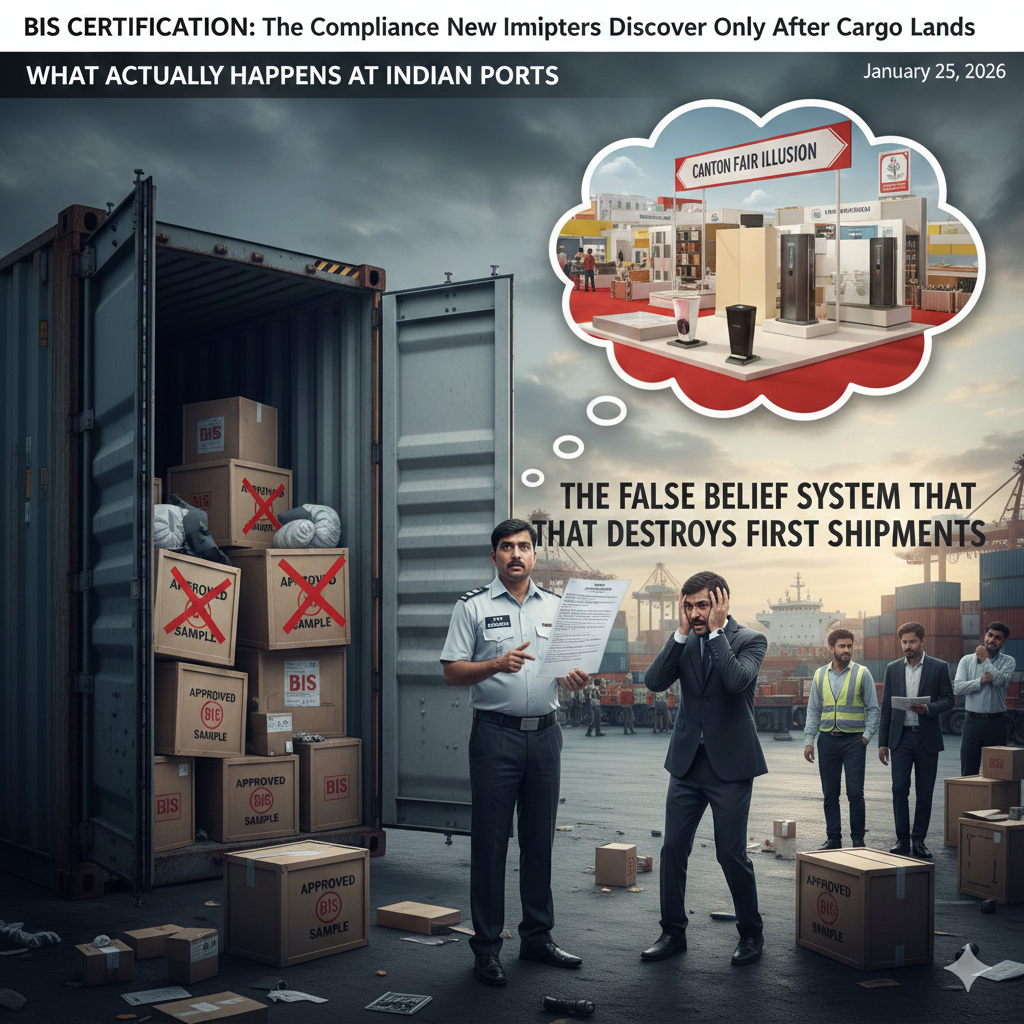
The Canton Fair Illusion: When “Approved Sample” Means Nothing at Indian Customs
You returned from Canton Fair Phase 1 with product catalogs, supplier quotations, and sample approvals. Your Chinese manufacturer promised “all certificates included.” Purchase order placed. Payment released. Shipment on water.
Then your Customs Broker calls: “Sir, your electronics consignment is detained at Nhava Sheva. BIS registration missing. Cargo cannot be cleared.”
This is not a hypothetical scenario. This is the standard pattern we have witnessed at Premji Kanji Masani Private Limited for six decades—since 1963, when most Canton Fair exhibitors were still assembling products in Shanghai backrooms.
The brutal truth: The Canton Fair does not prepare Indian buyers for the Bureau of Indian Standards (BIS) Compulsory Registration Scheme (CRS). And Chinese suppliers—despite their promises—cannot “arrange” BIS for you.
Canton Fair Phase 1: The BIS Minefield
Phase 1 (April 15–19 / October 15–19) showcases electronics, electrical equipment, machinery, and hardware—precisely the categories bearing the highest BIS exposure under India’s CRS regime.
Typical BIS-controlled products sourced at Phase 1:
- LED bulbs, tube lights, and luminaires
- Mobile chargers, power banks, and adapters
- Electric switches, circuit breakers, and MCBs
- Water heaters, immersion rods, and geysers
- Lithium-ion batteries and cells
- Household appliances (mixers, grinders, fans, irons)
- Steel tubes and pipes
- LPG equipment and pressure regulators
- Helmets (two-wheeler and industrial)
If your Canton Fair purchase list includes any of these, and your supplier has not mentioned BIS factory registration, you are importing contraband—not goods.
The False Belief System That Destroys First Shipments
Mistake 1: “Supplier Will Arrange BIS”
No. BIS certification is not a document your Chinese factory can courier to you after shipment.
BIS registration under CRS requires:
- Factory audit by BIS-empaneled Indian agencies physically conducted at the Chinese manufacturing facility
- Product testing in BIS-recognized Indian laboratories (not Chinese labs, not SGS reports)
- License issuance in the name of the Indian importer (not the Chinese exporter)
Your supplier can facilitate the audit. They cannot “arrange” BIS independently. The importer—you—must apply, bear costs, and hold the license.
Mistake 2: “Sample Approval = Production Approval”
You tested samples. BIS lab approved them. You placed a 10,000-unit order.
Shipment arrives. BIS officer at port draws samples from the actual consignment for re-testing. Result: failure. LED bulbs do not meet lumen output standards. Circuit breakers fail short-circuit endurance tests.
Why?
Because BIS does not certify your sample. BIS certifies the factory’s production process and quality control system. Mass production at unapproved factories—or factories that change components post-sample approval—yields non-compliant goods, regardless of sample test results.
BIS factory surveillance audits exist for this reason. Samples mean nothing without ongoing manufacturing compliance.
Mistake 3: “We’ll Apply for BIS After Shipment Lands”
BIS license processing timelines:
- Application submission to BIS: 1–2 weeks (document preparation)
- Factory audit scheduling: 3–6 weeks
- Audit execution and report submission: 2–3 weeks
- Product testing in Indian labs: 2–4 weeks
- License grant (if no deviations): 2–4 weeks
Total realistic timeline: 3–5 months.
Your container at Nhava Sheva port:
- Free detention period: 3–7 days
- Demurrage charges thereafter: ₹4,000–₹12,000 per day (20-foot container)
- Container detention charges: ₹500–₹2,000 per day
- Ground rent at CFS: additional daily cost
Mathematics: 30 days detention = ₹1.5 lakh to ₹4 lakh in penalties. 90 days = shipment value exceeded by storage costs.
You cannot “apply after landing.” Cargo will rot at the port while BIS processes your application—if they even accept a post-import application, which procedurally they should not.
What Actually Happens at Indian Ports: The PKM Front-Line Reality
Scenario A: Electronics Importer, First Shipment (Mundra Port, 2023)
Product: 5,000 LED bulbs (9W, branded packaging)
Supplier claim: “BIS not required for samples”
Actual position: BIS mandatory under IS 10322 (Part 5/Sec 13)
Port outcome: Detention under Customs (Import of Goods at Concessional Rate of Duty) Rules, 2017 (IGCR). Show-cause notice issued. Importer offered three options:
- Re-export at own cost (shipping + detention + restocking penalties to Chinese supplier)
- Destroy goods under Customs supervision (destruction charges + container charges)
- Apply for BIS license and wait (impossible within detention window)
Importer choice: Re-export.
Total loss: ₹8.2 lakh (product cost + freight + detention + reverse logistics).
BIS application fee if done pre-shipment: ₹15,000–₹50,000.
Scenario B: Mobile Charger Trader (JNPT, 2024)
Product: USB-C fast chargers, 2A-5A output
Supplier documentation: CE, RoHS, test reports from Shenzhen lab
Missing: BIS registration under IS 16046
Port action: Provisional release denied. Samples drawn for testing at BIS-recognized Chennai lab. Test result: failure (overheating beyond permissible limits under IS standards).
Final order: Confiscation under Section 111(d) of Customs Act, 1962. Option for redemption fine: ₹12 lakh (shipment value: ₹15 lakh).
Importer paid fine, re-exported goods at 80% loss. Chinese supplier refused refund (their test reports were “valid”).
Scenario C: Steel Tube Importer (Chennai Port, 2022)
Product: ERW steel tubes for furniture manufacturing
BIS requirement: IS 1161 / IS 1239 compliance + BIS license
Importer assumption: “Structural steel doesn’t need BIS”
Detention duration: 47 days
Outcome: After intervention by PKM and fast-track BIS consultant, license obtained. Goods cleared with penalty.
Costs incurred: BIS license (₹1.8 lakh) + detention (₹2.1 lakh) + penalty (₹80,000) + consultant fees (₹1.2 lakh).
Total avoidable cost: ₹5.9 lakh. Time lost: 47 days of dead inventory.
BIS Is Not Paperwork. BIS Is a Manufacturing Gatekeeper.
First-time importers treat BIS as a “certificate to obtain.” This is the foundational error.
BIS CRS is a factory registration system, not a product approval process.
What BIS actually verifies:
- Whether the Chinese factory has documented quality control procedures
- Whether raw material suppliers are approved
- Whether testing equipment is calibrated and certified
- Whether production batches are traceable
- Whether the factory allows unannounced surveillance audits post-registration
If your Canton Fair supplier’s factory is not already BIS-registered for the specific product under Indian standards, your goods are non-compliant—even if samples pass every lab test in the world.
This is why experienced importers ask one question before finalizing suppliers at Canton Fair:
“Is your factory BIS-registered for IS [relevant standard], and can you provide the Indian importer’s name under whose license you currently export?”
If the answer is vague, the factory is not BIS-ready. If they say “we will arrange,” they are lying or ignorant.
Why Chinese Suppliers Don’t Volunteer BIS Reality
Reason 1: Most Chinese factories export to 40+ countries. India is 2–5% of their sales.
They design for CE (Europe), FCC (USA), CCC (China domestic). BIS is an afterthought—addressed only when an Indian buyer specifically demands it.
Reason 2: BIS registration costs the factory money and exposes their processes.
Factory audit = external scrutiny. Many factories prefer to avoid this unless the order size justifies it (typically 50,000+ units annually).
Reason 3: “Certificate trading” racket.
Some suppliers offer “BIS certificates” for $200–$500. These are:
- Forged documents
- Licenses belonging to other Indian importers (illegally shared)
- Test reports from non-BIS labs formatted to look official
Customs officers verify BIS licenses online via the BIS portal in real-time. Fake certificates result in criminal prosecution under BIS Act, 2016 (imprisonment up to 2 years + fine up to ₹10 lakh).
The Pre-Canton Fair BIS Checklist (PKM Field Protocol)
Before You Book Your Guangzhou Flight:
Step 1: Identify whether your target product falls under BIS CRS
Check the latest BIS CRS order at bis.gov.in. As of January 2025, 450+ product categories are covered. Electronics, steel products, LPG equipment, and helmets are high-risk.
Step 2: Determine the applicable Indian Standard (IS code)
Example:
- LED bulbs → IS 10322 (Part 5/Sec 13)
- Mobile chargers → IS 16046
- MCBs → IS/IEC 60898-1
- Steel tubes → IS 1161, IS 1239
Step 3: Verify whether your existing/target suppliers hold BIS licenses
Ask suppliers to provide:
- BIS license number
- Name of Indian license holder (importer/brand owner)
- License validity period
- Copy of latest factory audit report
Cross-verify license authenticity on BIS portal (public database).
At the Canton Fair Booth:
Questions to ask (non-negotiable):
- “Is your factory BIS-registered under IS [code]? Show me the license.”
- “Which Indian company currently holds the BIS license for exports from this factory?”
- “What is your factory’s BIS audit history—how many audits conducted, any non-conformities?”
- “What is your minimum order quantity for BIS-registered production?” (Factories often refuse BIS registration for small trial orders.)
- “Can you provide contact details of your existing Indian BIS license holders as references?”
If answers are evasive, walk away. No supplier goodwill, no discounts, no “trial order” justifies BIS non-compliance.
What to collect at the fair:
- Factory audit reports (if BIS-registered)
- Product test reports from BIS-recognized Indian labs (not Chinese labs)
- Factory’s quality manual and process flow (indicates BIS-readiness even if not yet registered)
After Canton Fair, Before Purchase Order:
Step 4: Consult a licensed Customs Broker (not a “consultant”)
Customs Brokers operate under Customs Brokers Licensing Regulations, 2018, and are accountable to Customs authorities. Consultants are not.
At PKM, we perform pre-shipment compliance audits:
- Review supplier’s BIS documentation
- Identify gaps between supplier’s product specs and Indian Standard requirements
- Assess factory’s audit-readiness
- Calculate realistic BIS timelines vs. your shipment schedule
- Coordinate with BIS consultants/agencies for license application (if required)
Step 5: Initiate BIS application before placing purchase order
If the factory is not BIS-registered, you need 3–5 months lead time. Do not release payment, do not finalize shipping dates, until BIS license is in hand.
If the factory is registered under another Indian importer’s license, you need:
- Permission from that license holder (often refused for competitive reasons), OR
- Fresh license in your own name (factory remains the same, but license holder changes)
Step 6: Specify BIS requirements in purchase contract
Your proforma invoice / purchase order must state:
- “Goods must be manufactured at BIS-registered factory under License No. [X], held by [Indian importer name].”
- “Supplier shall affix BIS Standard Mark (ISI mark) on every unit as per IS [code].”
- “Supplier shall provide batch production certificate and test reports from BIS-recognized Indian labs prior to shipment.”
- “Shipment of non-BIS-compliant goods shall entitle buyer to reject consignment and claim full refund including freight and detention costs.”
Make BIS compliance a contractual obligation with financial penalty clauses. Otherwise, Chinese suppliers treat it as optional.
When the Factory Says “We Have BIS”—Verify, Don’t Trust
Red flags indicating fake or inapplicable BIS claims:
Red Flag 1: Factory shows a BIS license in someone else’s name and says “you can use this.”
BIS licenses are non-transferable. The license holder’s name appears on Customs documents. If the license is under another importer’s name, Customs will:
- Verify with BIS
- Contact the license holder to confirm authorization
- Reject clearance if license holder denies permission
You cannot “borrow” someone else’s BIS license.
Red Flag 2: Factory provides “BIS test report” from a Chinese lab.
BIS does not recognize foreign test reports for CRS products. Testing must be done at BIS-recognized Indian laboratories (NABL-accredited labs empaneled with BIS).
A test report from TUV China, SGS Shenzhen, or Intertek Guangzhou is invalid for Customs clearance, regardless of how official it looks.
Red Flag 3: Factory claims “BIS exemption for small shipments.”
No such exemption exists under BIS CRS. Whether you import 10 units or 10,000 units, BIS compliance is mandatory for CRS-listed products.
Some factories confuse India’s samples exemption (under Customs duty concessions) with BIS exemption. These are unrelated. Samples below ₹5 lakh value may get Customs duty relief, but they still require BIS compliance if the product is CRS-listed.
Red Flag 4: “We will arrange BIS after you place the order.”
If the factory is not already BIS-registered, “arranging” BIS takes 3–5 months. They cannot arrange it while manufacturing your order (typical production: 30–60 days).
Either they are lying, or they plan to ship non-compliant goods and hope you “manage” at Indian Customs (which you cannot).
The PKM Six-Decade Insight: What Experienced Importers Do Differently
Strategy 1: They shortlist suppliers based on BIS status before attending Canton Fair.
Pre-fair research identifies which exhibitors hold BIS registrations. These suppliers are prioritized during booth visits.
Strategy 2: They treat BIS timelines as shipment timelines.
Purchase orders are placed only after:
- BIS license is verified (for registered factories), OR
- BIS application is submitted and factory audit is cleared (for new registrations)
They do not gamble on “we’ll handle it later.”
Strategy 3: They work with Customs Brokers before supplier negotiations, not after cargo detention.
At PKM, our role begins at the product selection stage:
- We review Canton Fair product catalogs for BIS applicability
- We verify supplier BIS claims through our port network and BIS contacts
- We connect importers with BIS certification agencies before purchase orders
- We review proforma invoices for compliance gaps (labeling, marking, documentation)
Clearing Your Cargo, Retaining Your Trust, Since 1963—because we prevent problems before they board the vessel.
Strategy 4: They negotiate BIS costs into product pricing.
BIS registration costs (₹50,000–₹3 lakh depending on product and factory) are either:
- Absorbed by the supplier (for large orders), OR
- Factored into per-unit cost (for smaller orders)
They do not treat BIS as a surprise expense discovered at the port.
The Cost of Ignorance vs. The Cost of Compliance
Scenario: LED Bulb Import (10,000 units)
| Parameter | Without BIS (Post-Detention) | With BIS (Pre-Shipment) |
|---|---|---|
| Product cost (FOB) | ₹5,00,000 | ₹5,00,000 |
| Freight + insurance | ₹1,50,000 | ₹1,50,000 |
| BIS license cost | — | ₹80,000 |
| Detention (45 days avg.) | ₹2,70,000 | — |
| Re-export / destruction | ₹3,00,000 | — |
| Penalty / redemption fine | ₹2,00,000 | — |
| Consultant fees (emergency) | ₹1,50,000 | ₹30,000 (pre-shipment) |
| Total cost | ₹15,70,000 | ₹7,60,000 |
| Loss | ₹8,10,000 | — |
BIS compliance is not a cost. Non-compliance is.
Why “We’ll Apply for BIS from India” Fails 9 Times Out of 10
Problem 1: Factory refuses post-shipment audits.
Once your goods are shipped, the Chinese factory has been paid. They have zero incentive to accommodate BIS audit schedules, provide documentation, or allow inspectors into their facility.
BIS audits are announced 2–4 weeks in advance. If the factory is “too busy” or “under renovation” or “closed for Chinese New Year,” your audit—and your BIS license—gets delayed by months.
Meanwhile, your cargo sits at the port accumulating charges.
Problem 2: Product deviations discovered during Indian lab testing.
You shipped goods manufactured in October. BIS application was submitted in November. Indian lab testing happens in December.
Test results: failure.
BIS requires the factory to modify the product design or manufacturing process and submit fresh samples for re-testing.
But your shipment (manufactured in October) is already at Nhava Sheva. You cannot modify goods inside a sealed container at the port.
Result: Entire shipment is non-compliant. Re-export or destruction.
Problem 3: Indian lab testing backlogs.
BIS-recognized labs have 30–60 day testing queues for high-demand products (LED lights, chargers, MCBs). If you apply post-shipment, you join the back of the queue.
Your cargo cannot wait 60 days. Demurrage alone will exceed shipment value.
The Non-Negotiable Truth About Canton Fair and BIS
The Canton Fair is a sourcing event. It is not a compliance workshop.
Chinese exhibitors are salespeople, not Indian law experts. They will:
- Show you catalogs
- Negotiate prices
- Promise delivery timelines
- Provide CE/RoHS/FCC certificates (irrelevant for India)
They will not:
- Verify BIS applicability for your product under Indian law
- Explain IS standard requirements
- Warn you about factory audit timelines
- Refuse your order because you lack BIS readiness
That responsibility is yours—and your Customs Broker’s.
At Premji Kanji Masani Private Limited, we have cleared lakhs of consignments since 1963. The importers who succeed are not the ones who find the cheapest supplier at Canton Fair.
They are the ones who verify compliance before the purchase order, not after the port detention notice.
Your Pre-Shipment Advisory: What PKM Does Before Your Cargo Sails
If you are attending Canton Fair 2025 (April/October phases) and your product list includes BIS-controlled categories, consult PKM before you finalize suppliers.
Our pre-shipment protocol:
- Product-wise BIS applicability audit (we map your intended imports against current CRS lists and IS codes)
- Supplier BIS verification (we validate supplier claims through BIS portal checks and our factory network in China)
- Documentation gap analysis (we review proforma invoices, test reports, and supplier certificates for Customs compliance)
- Timeline planning (we calculate realistic BIS licensing timelines vs. your shipment schedules)
- Port-specific strategy (Nhava Sheva, Mundra, Chennai, and ICD Tughlakabad have different BIS enforcement intensities—we route shipments accordingly)
This is not a sales pitch. This is a detention prevention protocol.
Because we learned long ago: the best cargo clearance is the one that never faces an objection.
Clearing Your Cargo, Retaining Your Trust, Since 1963.
Premji Kanji Masani Private Limited
Licensed Customs Broker since 1963 Operating at Pipavav, Hazira, Nhava Sheva, Mundra, Chennai, Kolkata, ICD Tughlakabad, Ahmedabad ICD, Ahmedabad Air, Delhi Air and Mumbai Air Cargo
For pre-shipment BIS advisory and Canton Fair compliance review:
Consult us before you board the Guangzhou flight—not after the container is detained.


